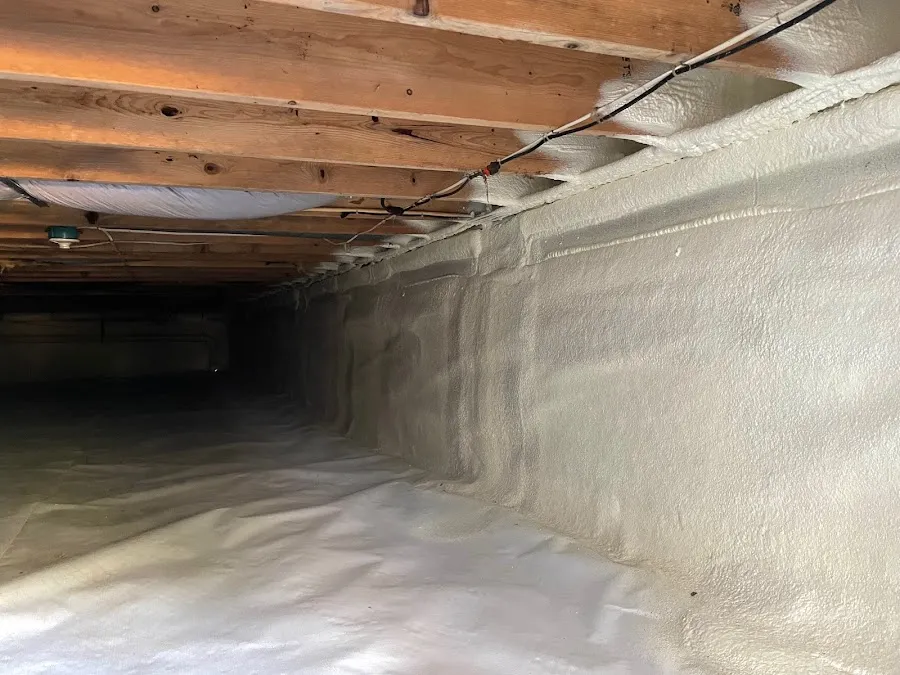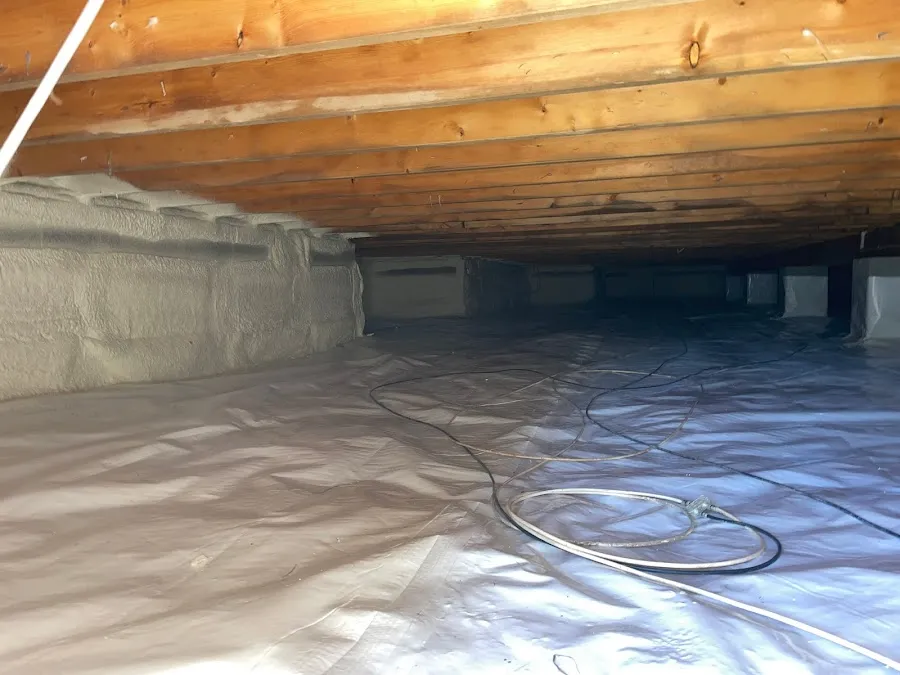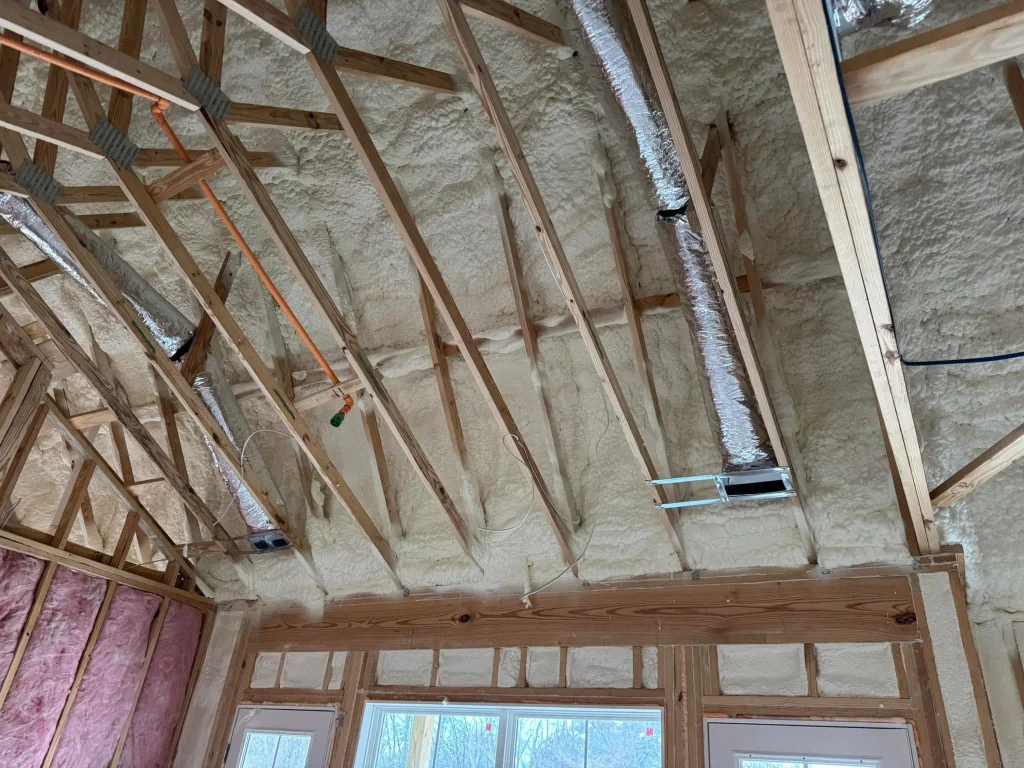
High Energy Bills? Insulation Solutions That Work in Easton, MD
High energy bills in Easton, MD, typically stem from inadequate insulation that fails to meet Climate Zone 4 requirements. Most…


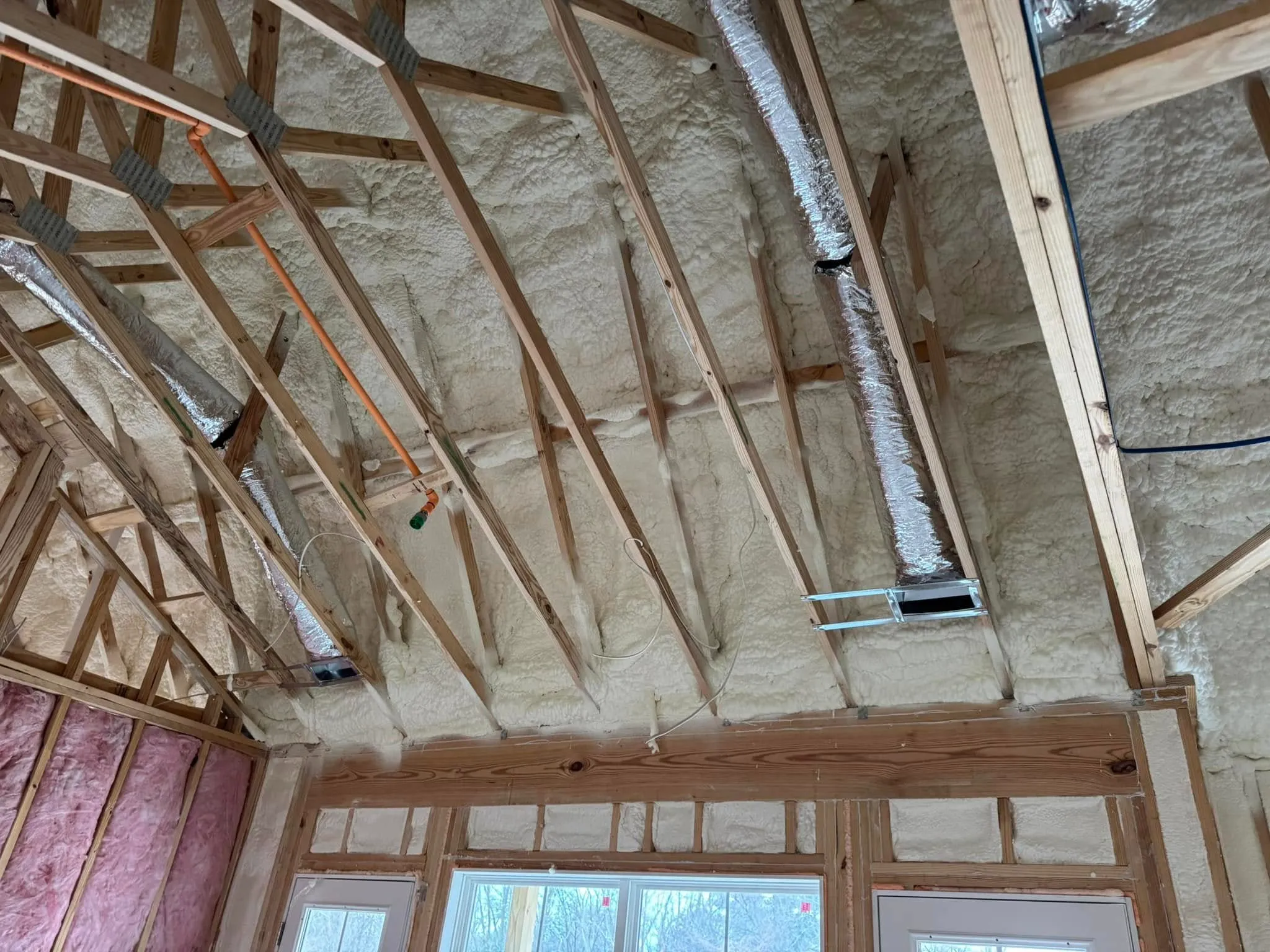
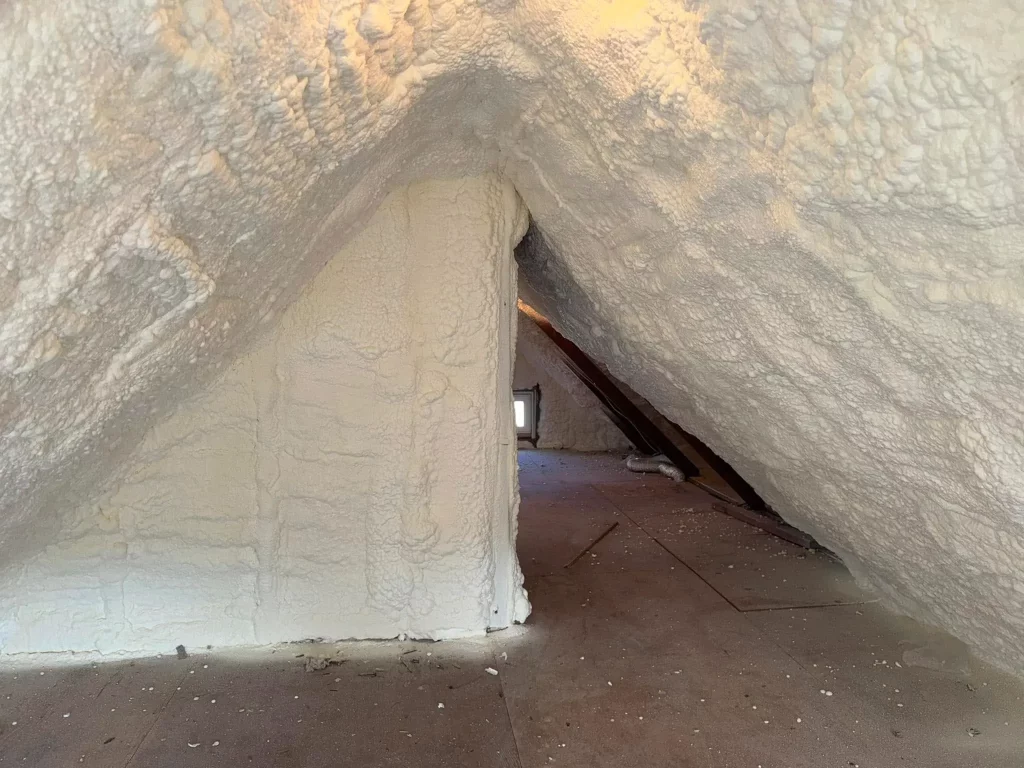
Open-cell spray foam insulation adapts to a home’s structure by expanding roughly 100 times its original liquid volume immediately upon application. This rapid expansion allows the material to fill every crack, crevice, and irregular void within wall cavities and attics before hardening into a semi-rigid state. Unlike rigid insulation boards or pre-cut batts, open-cell foam maintains some flexibility, allowing it to move with the building as framing settles or shifts due to seasonal temperature changes without breaking its air seal.
Effective insulation requires more than high thermal resistance; it demands a comprehensive air barrier tailored to the building’s specific geometry. Peninsula Insulation, LLC approaches this by recognizing that no two homes are framed exactly alike. Experience in the field shows that even new construction features slight irregularities in stud spacing and framing angles. Open-cell foam solves these inconsistencies by creating a custom-fit barrier each time, minimizing energy loss regardless of the building’s architectural quirks.
The primary advantage of open-cell spray foam lies in its chemical reaction. When the two components mix at the nozzle, the liquid triggers a gas response, causing the foam to billow out instantly. This is different from closed-cell foam, which expands less aggressively and cures to a rock-hard density.
Because the foam is low-density (roughly 0.5 pounds per cubic foot), it remains pliable. The open cell structure refers to the tiny bubbles within the foam that are broken or “open.” This structure traps air, slowing heat transfer. This specific composition allows the insulation to press itself against studs, joists, and sheathing without exerting enough pressure to warp the materials. It simply fills the available space and stops.
Most residential walls contain more than just space. They house electrical wiring, plumbing pipes, outlet boxes, and HVAC ducts. Traditional insulation materials, such as fiberglass batts, require installers to cut and piece together material around these obstacles. This manual process often leads to compression or gaps. According to the Department of Energy, voids and gaps in insulation can significantly reduce its effectiveness, sometimes by as much as 50 percent.
Open-cell foam flows around these obstructions. It engulfs wires and pipes, creating a complete seal without the need for precise cutting or fitting. This behavior is particularly valuable in attics with complex truss systems or in older homes where standard stud spacing (16 or 24 inches on center) was not strictly adhered to.
Bonus Tip: When planning for insulation in an attic with complex rooflines, verify that all electrical junction boxes remain accessible. While foam can easily fill around wires, codes require that junction boxes not be permanently buried behind the insulation.
Houses are dynamic structures. Wood framing expands during humid summers and contracts during dry winters. Over time, foundations settle, causing slight shifts in wall and roof alignment. Rigid insulation materials cannot accommodate this movement. If a house shifts, rigid foam or caulk seals may crack or separate from the framing, reopening pathways for air leakage.
Open-cell foam possesses a sponge-like elasticity. It stays adhered to the wood framing even as that wood moves. This flexibility maintains the integrity of the air barrier throughout the home’s lifespan. This creates a “monolithic” envelope, meaning the insulation acts as one continuous sheet rather than individual pieces.
Air leakage contributes to a significant portion of a home’s heating and cooling costs. A report by Building Science Corporation indicates that air barrier systems, like spray foam, are essential for controlling moisture and heat flow. Their research highlights that controlling air movement is often more important for energy efficiency than R-value alone. By adapting to the structure’s movement, open-cell foam prevents the formation of new air leaks years after installation.
Beyond thermal regulation, the open-cell foam structure offers acoustic benefits. The material’s soft, porous nature absorbs sound waves rather than reflecting them. When applied in wall cavities, it reduces the transmission of airborne noise, such as traffic outside or television volume between rooms, according to the Insulation Institute.
This happens because the foam fills the voids where sound would typically reverberate. While it does not soundproof a room entirely (which requires a decoupled structure), it significantly dampens mid- to high-frequency noise. This makes it a practical choice for interior walls around laundry rooms, bathrooms, and home theaters.
Different insulation types react differently to the physical realities of a building. The table below outlines how open-cell foam compares with other common materials in terms of adaptability and fit.
| Feature | Open-Cell Spray Foam | Closed-Cell Spray Foam | Fiberglass Batts |
|---|---|---|---|
| Expansion Ratio | High (~100x) | Medium (~30-40x) | None (Pre-formed) |
| Flexibility | High (Semi-rigid/Sponge-like) | Low (Rigid/Brittle) | High (Soft fibers) |
| Gap Filling | Excellent (Expands into voids) | Good (Expands, but less spread) | Poor (Requires manual fitting) |
| Movement Tolerance | Moves with structure | Can crack if the structure shifts | Can sag or settle over time |
| Adhesion | Adheres aggressively to wood | Adheres aggressively, adds strength | Friction fit or stapled |
While the adaptability of open-cell foam is a strong asset, certain factors determine if it is the right fit for a specific project.
Moisture Permeability: Open-cell foam is vapor-permeable. It allows moisture vapor to pass through it, which can be beneficial in assembly designs that need to dry out in two directions. However, this means it should not be used in areas constantly exposed to water or in high-humidity areas without a proper vapor retarder, such as below-grade basements or directly against metal roof decks in cold climates.
R-Value Constraints The R-value (resistance to heat flow) of open-cell foam is typically around R-3.5 to R-3.8 per inch. Because it fills the entire cavity, the effective R-value remains high. However, in shallow wall cavities where maximum thermal resistance is required, closed-cell foam might be necessary to meet code requirements due to its higher density.
Bonus Tip: Check local building codes regarding vapor retarders. In some climate zones, installing a Class II vapor retarder over open-cell foam on the warm side of the wall is required to effectively manage moisture diffusion.
Yes, applying open-cell foam to the underside of the roof deck is a common practice to create an unvented attic assembly. This brings the attic space into the conditioned envelope of the house, protecting HVAC equipment there from extreme temperature swings.
Open-cell foam is not waterproof. If a roof leak occurs, water will eventually pass through the foam. While this allows you to spot the leak sooner than with closed-cell foam (which might trap water and rot the decking), the wet insulation will not dry out quickly and may need to be removed and replaced after the roof is repaired.
Quality open-cell foam, mixed at the correct ratio and temperature, is dimensionally stable. It does not shrink significantly after the initial curing period (which happens within seconds to minutes). Shrinkage is usually a sign of improper installation or poor chemical mixture.
No, spray foam does not provide nutritional value to rodents or insects. However, it is soft enough that determined pests can tunnel through it. It serves as a barrier that seals scent paths, which can discourage pests from entering, but it is not a pesticide or a physical shield like steel wool.
Open-cell spray foam provides a dynamic solution for insulating modern and historic homes. Its ability to expand 100 times its volume ensures that complex framing, wiring, and plumbing do not compromise the thermal envelope. By remaining flexible, it maintains an air seal even as the house settles and seasons change. This adaptability leads to consistent energy performance and improved indoor comfort.
Homeowners should evaluate their specific climate zone and moisture control needs when choosing insulation. A tight, well-sealed home is the foundation of energy efficiency. Assessing the long-term benefits of an insulation that moves with your home will guide you toward the right investment for your property.
If you are dealing with drafty rooms or inconsistent temperatures, your insulation might not be adapting to your home’s needs. Peninsula Insulation, LLC specializes in creating custom-fit thermal barriers for homes in the region. Contact the team at (410) 770-2624 or email wil@mdsprayfoam.net to discuss your project requirements. Proper installation ensures your home stays comfortable and efficient for years to come.