High Energy Bills? Insulation Solutions That Work in Easton, MD
High energy bills in Easton, MD, typically stem from inadequate insulation that fails to meet Climate Zone 4 requirements. Most…


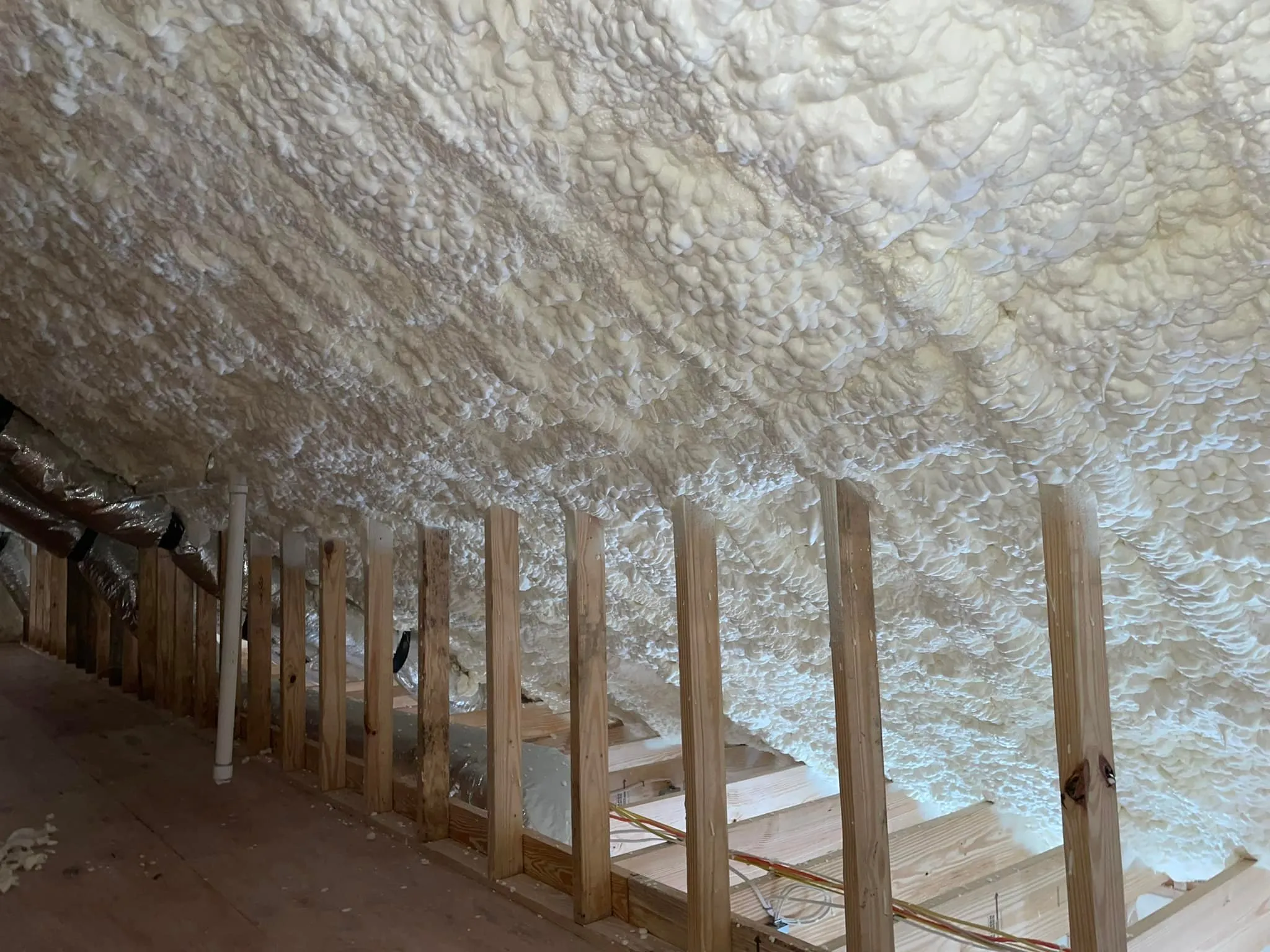
Imagine standing in your attic on a sweltering July afternoon. In most homes, the heat is suffocating, radiating down from the roof deck and making the space unbearable. Now, imagine that same attic staying within a few degrees of your living room temperature, regardless of the weather outside. This isn’t magic. It is building science in action, specifically achieved through the application of spray polyurethane foam (SPF).
When you start researching insulation, you quickly encounter two leading contenders in the foam category: open-cell and closed-cell. While both provide superior performance compared to traditional fiberglass or cellulose, they serve different purposes. This guide focuses entirely on open-cell spray foam.
We wrote this guide because there is often confusion about what open-cell foam actually does. Some homeowners worry it holds water like a sponge. Others aren’t sure if it insulates as well as the denser closed-cell variety. Over the years, we have seen how the right insulation strategy can transform a family’s experience of their home. It is about more than just lower energy bills. It is about consistent comfort, quieter rooms, and cleaner air.
In this comprehensive resource, you will learn precisely what open-cell foam is, how the installation process works, where it belongs in your home, and where it does not. We will break down the costs, the physics, and the long-term performance so you can decide if this material matches your project’s needs.
To make an informed decision, you first need to understand the material itself. Open-cell spray foam, often referred to as “half-pound foam” due to its density (approximately 0.5 lbs per cubic foot), is a two-component mixture. When these chemicals combine at the nozzle of a spray gun, they undergo a rapid reaction.
The term “open-cell” refers to the microscopic structure of the cured foam. The tiny cells that make up the foam are not entirely closed; they are partially open or broken. This structure allows air to fill the material’s spaces. Because of this, the foam is soft and flexible. You can easily crush it with your hand, similar to the foam found in a sofa cushion or a mattress.
This structure dictates its performance characteristics. Since the cells are open, the R-value (thermal resistance) relies heavily on the trapped air inside the foam matrix.
One of the most distinct features of open-cell foam is its aggressive expansion rate. According to technical data from the Spray Polyurethane Foam Alliance, open-cell foam can expand up to 100 times its liquid volume within seconds of application.
This massive expansion is a significant advantage. It allows the foam to penetrate deep into cracks, crevices, and odd-shaped voids that stiffer materials would miss. It creates a seamless air barrier by filling every available inch of the wall or roof cavity.
R-value measures how well a material resists the flow of heat. The higher the number, the better the insulation.
While closed-cell foam gets attention for its structural strength and water resistance, open-cell foam offers distinct advantages that make it the preferred choice for many residential applications.
If you live near a busy street, an airport, or simply want to isolate noise between a game room and a bedroom, open-cell is the superior option. The soft, sponge-like consistency absorbs sound waves rather than reflecting them.
A report on acoustic performance by Building Science Corporation highlights that open-cell foam significantly reduces airborne noise transmission. It functions similarly to the acoustic foam used in recording studios. It won’t make a room soundproof, but it will create a noticeably quieter environment compared to other insulation types.
Air leakage is responsible for a massive amount of energy loss in average homes. The U.S. Department of Energy estimates that air leaks alone can account for 25% to 40% of the energy used for heating and cooling.
Open-cell foam creates an air seal the moment it is applied. Because it expands so aggressively, it seals around:
By stopping air leakage, you stop the drafty feeling in your home and reduce the workload on your HVAC system.
Expert Tip: While open-cell is an air barrier, it is not a vapour barrier. In Climate Zones 5 and higher (colder regions), building codes usually require the installation of a vapour retarder (like 6-mil plastic or vapour-barrier paint) over the foam on the warm side of the wall.
For many projects, budget is a primary constraint. Open-cell foam is significantly more affordable than closed-cell foam. Because the material expands so much, a single set of chemical drums yields far more finished foam. You get the benefits of a spray foam application, air sealing and high performance at a price point that is often closer to upgraded fiberglass systems than to closed-cell systems.
Houses settle. Lumber shifts as it dries and ages. Because open-cell foam is flexible, it moves with your home. It is less likely to pull away from the studs or crack over time compared to more rigid insulation materials. This ensures that the air seal remains intact for the life of the building.
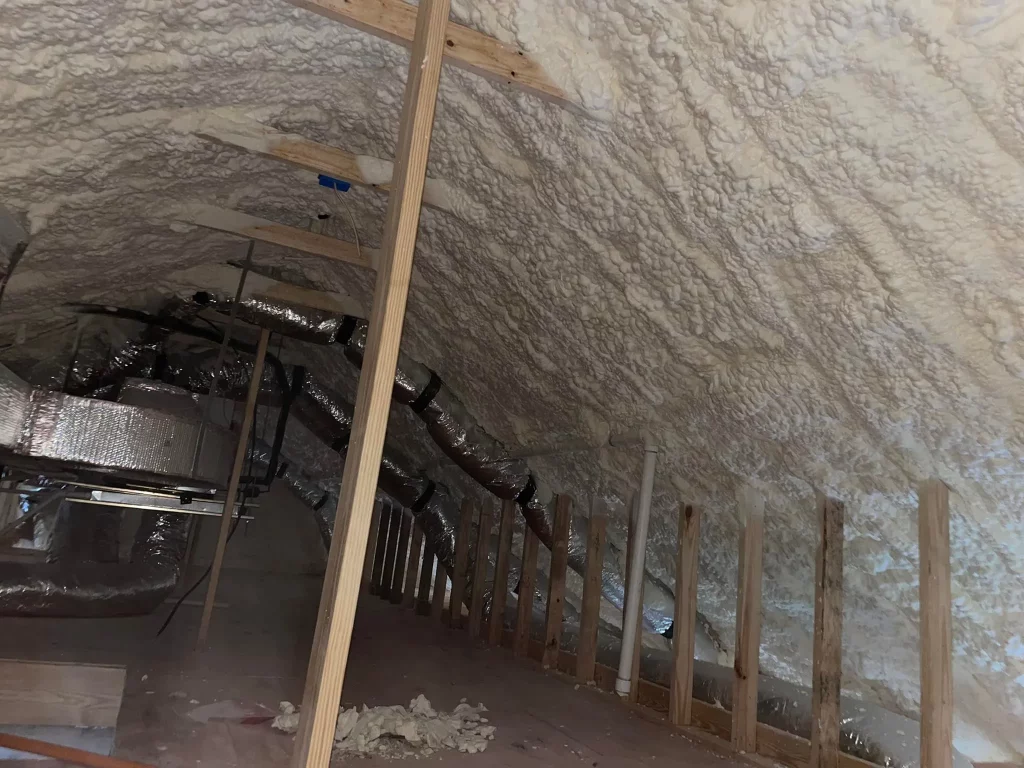
Not every location in a house is suitable for open-cell foam. Understanding the “Where” is just as important as the “What.”
The most popular application for open-cell foam is the underside of the roof deck. By spraying the roofline, you shift the thermal boundary of the house from the attic floor to the roof.
We frequently apply open-cell foam in walls between rooms (partition walls) specifically for sound control. Bathrooms, laundry rooms, and media rooms are prime candidates.
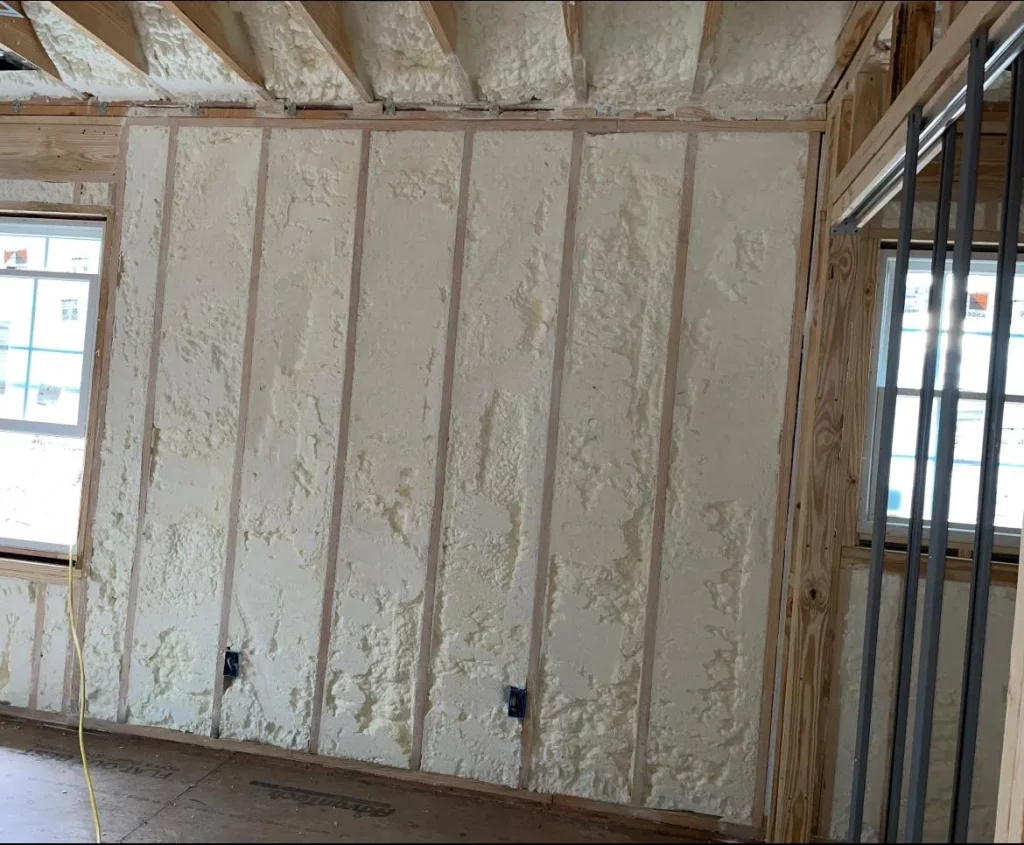
Open-cell is excellent for standard 2×4 or 2×6 exterior walls. It fills the cavity. However, because it is permeable to water vapour, the wall assembly can dry in both directions if moisture ever gets in. This “breathability” can be a safety feature for the wood framing, provided moisture is managed correctly on the exterior.
Similar to interior walls, spraying the underside of a subfloor between the first and second story helps with sound transmission. It also helps isolate temperature zones in a multi-zone HVAC system.
We need to be clear about limitations. There are specific environments where open-cell foam is the wrong choice and could lead to failure.
You should never use open-cell foam in direct contact with masonry, concrete, or in areas prone to high moisture or flooding.
You cannot apply open-cell foam to the top side of a roof (commercial roofing foam). It is strictly for interior use. It is too soft and not water-resistant enough to withstand the elements.
While you can buy “froth packs” at hardware stores, they are generally closed-cell foam. Open-cell requires high-pressure, heated professional equipment to apply correctly. It is not a DIY-friendly material.
At Peninsula Insulation, LLC, you should know precisely what happens when a crew arrives at your property. Here is the standard workflow for an open-cell installation.
Spray foam is a messy process. The chemicals are sticky and airborne during application.
The installer sprays the liquid mixture into the wall or roof cavity. It looks like water coming out of the gun, but within seconds, it erupts into a fluffy, white foam that overflows the studs.
This step is unique to open-cell foam. Because it expands so much (often expanding past the studs), it must be trimmed flush so drywall can be installed.
The shaved foam generates significant waste. The crew bags up the trimmings and removes the masking from windows and floors.
A final check ensures no voids were missed and the foam is fully cured. If a vapour retarder is required by code, it is applied at this stage.
To help you visualize the differences, here is a comparison of how open-cell stacks up against other common insulation types.
| Feature | Open-Cell Spray Foam | Closed-Cell Spray Foam | Fiberglass Batt |
|---|---|---|---|
| R-Value per Inch | ~3.5 – 3.7 | ~6.0 – 7.0 | ~3.0 – 3.5 |
| Air Barrier | Yes | Yes | No |
| Vapor Barrier | No (Permeable) | Yes (Semi-impermeable) | No |
| Water Resistance | Low (Absorbs water) | High (Deflects water) | Low (Holds water) |
| Sound Dampening | Excellent | Good | Fair |
| Structural Strength | None | Adds rigidity to walls | None |
| Cost | Moderate | High | Low |
Hard data regarding energy consumption support the shift toward spray foam. A study by indicates that the building thermal insulation market is growing rapidly, driven specifically by stricter energy codes and the demand for reduced carbon footprints.
Furthermore, data from the EPA Energy Star Program suggests that homeowners can save an average of 15% on heating and cooling costs (or an average of 11% on total energy costs) by air sealing their homes and adding insulation in attics, floors over crawl spaces, and basements. Because spray foam handles both air sealing and insulating in one step, it is often the most efficient route to achieving these savings.
Key Takeaway: Open-cell foam is not just about keeping heat out; it is about controlling airflow. By sealing the thousands of tiny gaps in a building envelope, you stop the mechanism that forces your HVAC system to run overtime.
There is plenty of misinformation circulating about spray foam. Let’s address the most common concerns regarding open-cell applications.
This is a frequent worry with roof-deck applications. The concern is that if the roof leaks, the foam will hide the leak, trapping water against the wood.
Once cured, spray foam is inert. The off-gassing period is short, typically 24 hours. We strictly adhere to manufacturer guidelines regarding re-entry times to ensure occupant safety. Low-VOC (Volatile Organic Compound) formulas are now standard in the industry.
Foam does not provide a food source for termites, mice, or insects. However, it is soft enough that rodents can chew through it if they want to get in.
Is open-cell foam worth the investment? The upfront cost is higher than fiberglass, but the ROI calculation involves more than just the installation price.
No. Open-cell foam requires complex machinery that heats the chemicals to precise temperatures and mixes them at high pressure. The equipment costs tens of thousands of dollars, and the application requires professional training to ensure safety and proper chemical reaction.
Open-cell foam creates a pathway for water to move. If it gets saturated from a burst pipe or roof leak, it will dry out eventually, but its structure may be compromised if it stays wet for too long. In many cases, you may need to cut out the wet section and respray it to prevent mold growth within the matrix.
During application, there is a distinct chemical odor. This is why you must leave the house. Once the 24-hour curing period is over and the house has been ventilated, there should be no lingering odor. If an odor persists, it usually indicates an installation issue (off-ratio mixing), which requires professional remediation.
Indefinitely. As long as it is protected from UV light (sunlight degrades foam) and physical damage, spray foam will last the life of the building without losing R-value.
Many modern open-cell foams use water as the blowing agent (the component that causes expansion), rather than high-GWP (Global Warming Potential) chemicals. Additionally, by significantly reducing a home’s energy consumption, the building’s carbon footprint drops drastically over its lifespan.
Choosing the right insulation is one of the few home improvements that pays you back every month. Open-cell spray foam offers a unique balance of high performance, air-sealing capabilities, and cost-effectiveness. It is particularly well-suited for attics, interior soundproofing, and standard residential wall cavities.
By creating a sealed thermal envelope, you are not just insulating; you are controlling the environment in which you live. You eliminate drafts, reduce noise, and gain control over your humidity and temperature.
If you are planning a new build, a renovation, or simply want to fix an uncomfortable attic, evaluate your specific needs. Consider the climate, the application location, and your budget. With the right planning and professional installation, open-cell foam can transform the feel and efficiency of your property for decades to come.
Navigating insulation options can be complex, but you don’t have to do it alone. If you have questions about whether open-cell foam is the right fit for your specific project, Peninsula Insulation, LLC is here to help. Contact us at (410) 770-2624 or email wil@mdsprayfoam.net to discuss your needs and schedule a consultation.