What Materials Are Commonly Used for Crawl Space Encapsulation in 2026, and Why Do They Matter?
Most crawl space encapsulation material choices in 2026 fall into five groups: a polyethylene vapor barrier over the soil and…


You step into your pole barn on a January morning, and the breath hangs in the air like fog. The tools on your workbench have a thin layer of frost. That expensive space heater is running full blast, and you are still freezing. Sound familiar? This is the reality for thousands of pole barn owners who skipped or undersized their insulation, and it is not just a comfort problem. Uncontrolled moisture eats away at metal panels, rots wooden framing, and drives up energy bills month after month.
The good news is that pole barn insulation does not have to be complicated or overwhelming. With the right approach, you can turn a drafty metal shell into a comfortable, dry, and energy-efficient space. This guide covers every angle: the different insulation types available, what each one actually costs, the problems that trip people up most often, and the solutions that actually work. Whether you are building a new post-frame structure or retrofitting an existing one, the information here comes from years of hands-on experience working on pole barns across the mid-Atlantic region.
A pole barn, more formally known as a post-frame building, uses large poles or posts set into the ground or on a foundation to carry the structural load. This means the exterior walls are not load-bearing in the traditional sense. Instead, horizontal girts span between the posts, and metal panels attach to the outside. This construction method makes pole barns fast to build and highly cost-effective compared to stick-frame structures, which is why they have become so popular for everything from agricultural storage to full-time residences.
But that same design creates insulation challenges that do not exist in conventional buildings. The metal exterior panels conduct heat rapidly. In summer, they turn the interior into an oven. In winter, they pull warmth out of the space constantly. The wide spacing between posts (often 8 feet or more) means wall cavities are deeper and wider than a standard stud wall, which affects how insulation performs. And because many pole barns are built without a continuous air barrier, drafts sneak in through every gap, seam, and penetration.
Insulation solves all of these problems at once. It slows heat transfer through walls and ceilings, reduces air infiltration when paired with proper sealing, and prevents condensation from forming on cold metal surfaces. According to the U.S. Department of Energy, proper insulation can reduce heating and cooling costs by up to 15% in typical buildings. For a pole barn with its large, exposed surface area, the savings can be even more noticeable.
Not every pole barn needs insulation in every zone. The right approach depends on your climate, your budget, and how you use the building. But understanding the three main zones helps you make smart decisions about where to prioritize your investment.
Walls are the most common area to insulate, especially in heated or air-conditioned pole barns. Wall insulation goes between the girts, the horizontal framing members that support the exterior metal panels. In a standard pole barn with 2×6 or 2×8 girts, you have room for R-19 to R-30 fiberglass batts, which handle most climate zones comfortably.
Ceilings and attics are where the biggest energy losses happen. Hot air rises, and an uninsulated metal roof radiates that heat away quickly. In a conditioned pole barn, ceiling insulation is actually more important than wall insulation. Most contractors recommend blown-in cellulose or fiberglass in the attic space to achieve R-38 or higher. [Link to: Detailed Guide on Attic Insulation for Pole Barns]
Floors are optional but worth considering in cold climates. Rigid foam board installed beneath a concrete slab prevents ground-cold from seeping up into the space. This matters most for workshops, offices, or living spaces where people stand or sit on the floor for extended periods.
Key Takeaways:
R-value is the standard measurement for thermal resistance. It tells you how well a material resists the flow of heat. A higher R-value means better insulation performance. According to ENERGY STAR, R-value is the single most important factor when comparing insulation materials.
Different materials deliver different R-values per inch of thickness. Fiberglass batts provide roughly R-3.1 to R-3.5 per inch. Blown-in cellulose delivers about R-3.2 to R-3.8 per inch. Spray foam insulation ranges from R-3.7 per inch for open-cell to R-6.5 or higher per inch for closed-cell. Rigid foam boards like polyiso can reach R-6.0 to R-6.5 per inch.
The International Energy Conservation Code (IECC) divides the United States into eight climate zones, each with different insulation requirements. While a detached, unheated storage barn may not need to meet code, any conditioned space, residential addition, or commercial building will need to comply.
| Climate Zone | Wall R-Value | Ceiling R-Value | Floor R-Value |
|---|---|---|---|
| Zones 1-3 (Hot) | R-13 to R-20 | R-30 to R-38 | R-13 |
| Zones 4-5 (Mixed) | R-20 to R-23 | R-38 to R-49 | R-19 to R-25 |
| Zones 6-7 (Cold) | R-20 to R-25 | R-49 to R-60 | R-25 to R-30 |
| Zone 8 (Very Cold) | R-25+ | R-60+ | R-30+ |
These numbers represent minimums for code compliance. If you want better energy performance, exceeding the minimum by 20 to 30 percent is a smart move, especially in the ceiling, where heat loss is greatest.
Expert Tip: Do not get fixated on hitting an exact R-value number. The real-world performance of your insulation depends heavily on installation quality. Even R-30 insulation installed with gaps and compressed spots will underperform compared to R-19 installed properly with full coverage and no voids. [Link to: Detailed Guide on R-Value and Insulation Performance]
Choosing the right insulation material is the most consequential decision you will make for your pole barn. Each option has distinct strengths, weaknesses, and ideal applications. Here is a detailed look at every major type.
Fiberglass batts are the most widely used insulation in pole barns, and for good reason. They are affordable, widely available at any home improvement store, and straightforward enough for a capable DIYer to install. Fiberglass batts come in pre-cut widths designed to fit between standard framing spacings, which makes them a natural fit for pole barn girts.
Typical fiberglass batts with 6-inch thickness deliver around R-19, while 8-inch options reach R-25 to R-30. When installed with a vinyl-facing, fiberglass batts also double as a vapor barrier, which helps control moisture.
Pros:
Cons:
Best for: Budget-conscious projects, detached garages and workshops, wall insulation in mixed climates, and situations where the building owner wants to handle installation personally.
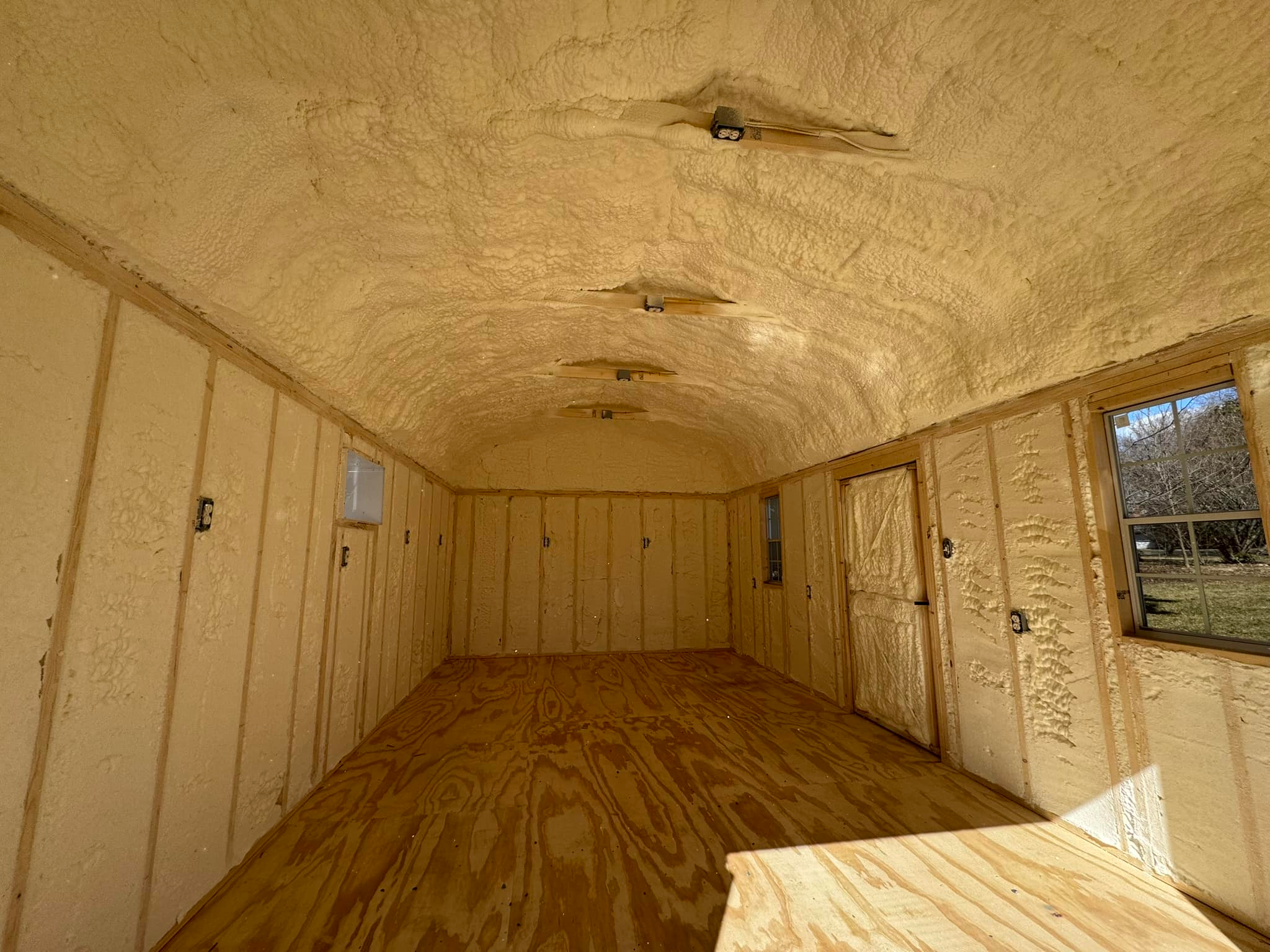
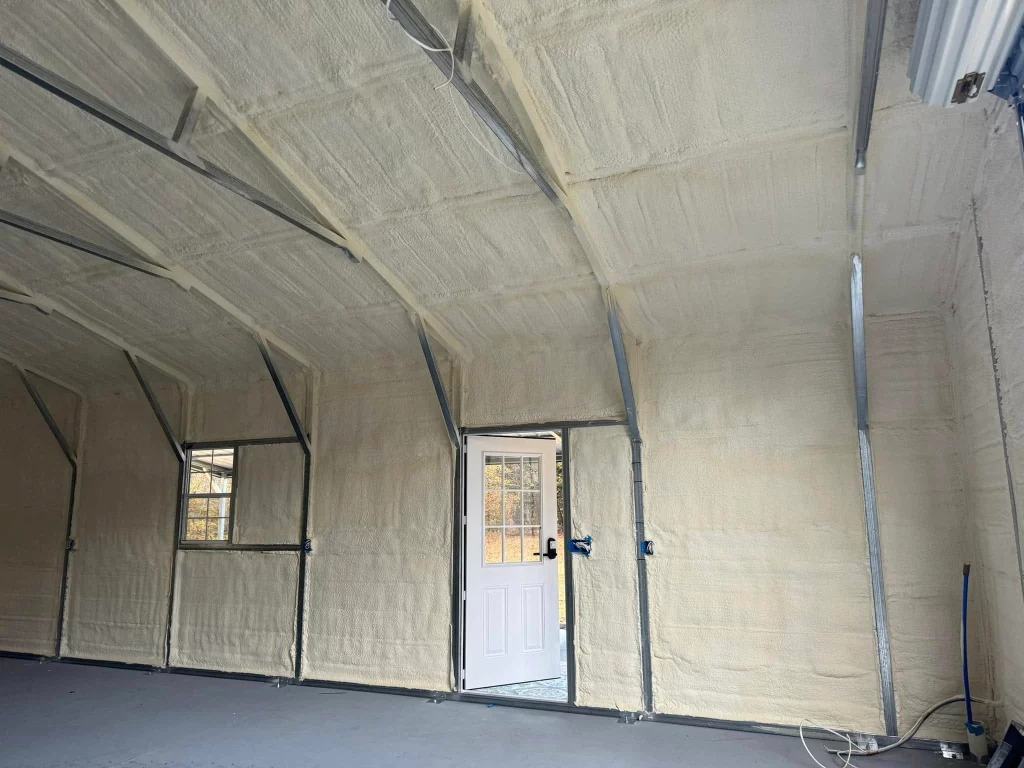
Spray foam has earned a reputation as the highest-performing insulation for pole barns, and in many ways, it deserves that reputation. Spray foam expands on application to fill every crack, gap, and void, creating both an insulating layer and an airtight seal in a single step. This dual function makes it particularly effective for pole barns, where air leakage through girt connections and panel seams is a major source of energy loss.
There are two types of spray foam. Open-cell foam is lighter, less expensive, and has an R-value of about R-3.7 per inch. It expands significantly, filling irregular spaces, but it does not act as a vapor barrier. Closed-cell foam is denser, more expensive, and delivers R-6.5 or more per inch. It also serves as a vapor barrier and adds structural rigidity to the building.
Pros:
Cons:
Expert Tip: If you choose spray foam but want to preserve the ability to replace steel panels later, have a house wrap like Tyvek installed under the exterior metal first. The spray foam goes on the interior side of the wrap. You get the air-sealing benefits of foam while keeping the panels removable.
Best for: Climate-controlled spaces where energy efficiency is the top priority, barndominiums, and pole barns used as full-time living or working spaces.
Rigid foam board, including polyiso, EPS, and XPS varieties, provides high R-value in a thin, lightweight package. Polyiso (polyisocyanurate) boards typically offer R-5.6 to R-6.5 per inch, making them one of the most efficient rigid insulation options available.
Rigid foam boards are most commonly used under concrete slabs, as continuous insulation on walls, and in ceiling applications where depth is limited. Because they come in large sheets, they install quickly and create fewer joints and seams than other materials.
Pros:
Cons:
Best for: Under-slab insulation, continuous wall insulation layered behind interior finishes, ceiling applications with limited depth, and projects where DIY installation is preferred.
Blown-in insulation, typically made from cellulose or fiberglass, is installed using a machine that forces loose material into cavities or spreads across attic floors. Cellulose is made from recycled paper treated with fire retardants, while blown-in fiberglass consists of fine glass fibers.
The big advantage of blown-in insulation is its ability to fill irregular spaces completely, conforming to obstacles and eliminating voids. For attic spaces in pole barns, blown-in insulation is often the most practical choice because it can be installed over the ceiling without the need for extensive framing.
Cellulose delivers roughly R-3.2 to R-3.8 per inch, depending on density. A 10 to 12 inch layer achieves R-38 to R-49, which meets or exceeds code requirements in most climate zones. According to Walters Buildings, blown-in insulation offers superior performance to fiberglass batts in attic spaces because it conforms to the space without leaving air gaps.
Pros:
Cons:
Best for: Attic spaces above a finished ceiling, retrofit projects where existing walls are already closed, and pole barns where the ceiling is the primary insulation priority.
Reflective insulation and radiant barriers work differently from bulk insulation materials. Instead of slowing conductive heat flow, they reflect radiant heat away from the building. These products typically consist of a foil layer laminated to a foam core or bubble-wrap substrate.
Radiant barriers can block up to 97% of radiant heat transfer, which makes them particularly useful in hot climates where the sun beating down on a metal roof is the primary source of heat gain. They also serve as a vapor barrier when installed with foil facing toward the interior.
Pros:
Cons:
Best for: Hot climates, unheated storage buildings, roof applications to reduce solar heat gain, and as a supplemental layer alongside bulk insulation.
| Feature | Fiberglass Batts | Spray Foam (Closed-Cell) | Rigid Foam Board | Blown-In (Cellulose) | Reflective/Radiant |
|---|---|---|---|---|---|
| R-Value per Inch | R-3.1 to R-3.5 | R-6.0 to R-7.0 | R-5.6 to R-6.5 | R-3.2 to R-3.8 | R-1 to R-8 |
| Air Sealing | Poor | Excellent | Moderate (with sealed joints) | Good | Poor |
| Vapor Barrier | With facing only | Yes (closed-cell) | Varies by product | No | Yes (foil side) |
| DIY Friendly | Yes | No (professional only) | Yes | No (needs equipment) | Yes |
| Installed Cost (per sq ft) | $0.50 to $1.50 | $1.00 to $4.50 | $1.00 to $2.50 | $0.80 to $2.00 | $0.30 to $1.00 |
| Best Application | Walls | Full building envelope | Floors, walls, ceilings | Attics | Roofs in hot climates |
Cost is the factor that drives most decisions about pole barn insulation, and for good reason. The difference between the cheapest and most expensive options can be fivefold or more. Understanding the real costs, not just material prices but installed costs, helps you budget accurately and avoid surprises.
According to Walters Buildings, most pole barns fall in the $5,000 to $8,000 range for full insulation. Here are some representative numbers based on building footprint and material choices:
| Building Size | Fiberglass Batts + Blown-In Attic | Spray Foam (Walls & Ceiling) |
|---|---|---|
| 30 x 40 (1,200 sq ft) | $3,500 to $5,000 | $5,000 to $10,000 |
| 40 x 60 (2,400 sq ft) | $6,000 to $9,000 | $10,000 to $20,000 |
| 50 x 80 (4,000 sq ft) | $9,000 to $14,000 | $16,000 to $32,000 |
| 60 x 100 (6,000 sq ft) | $12,000 to $20,000 | $24,000 to $48,000 |
These figures include materials and professional installation. The larger the building, the lower the cost per square foot tends to be because the crew and equipment mobilization costs are spread across a larger area.
Material prices fluctuate, but here is a general cost comparison for installed insulation on a per-square-foot basis:
Keep in mind that “per square foot” and “per board foot” are different measurements. Board foot pricing accounts for thickness, so 2 inches of closed-cell spray foam at $1.50 per board foot translates to $3.00 per square foot.
Expert Tip: Do not automatically go with the cheapest option. A well-installed fiberglass system with proper vapor barriers and air sealing will outperform a poorly installed spray foam job. Invest in quality installation regardless of material choice.
Key Takeaways:
Insulation problems in pole barns tend to follow predictable patterns. After seeing hundreds of installations, the same issues show up repeatedly. Understanding these problems before they happen gives you a major advantage.
This is the number one problem, hands down. Condensation in a pole barn happens when warm, moist air comes into contact with cold metal surfaces. The moisture in the air condenses into liquid water droplets, which then drip down onto everything below. According to Metalguard, condensation is one of the most widespread concerns for metal building owners and can lead to long-term structural issues.
Common signs of condensation problems include water dripping from ceiling purlins, damp or sagging insulation, rust spots on structural steel, mold or mildew growth on walls and stored items, and a persistent musty smell even when the building is empty.
Condensation does more than make things wet. It rusts metal panels and fasteners, rots wooden posts and girts, promotes mold growth that can affect air quality, soaks into fiberglass insulation, causing it to lose R-value, and damages stored equipment, feed, and materials.
The cause is straightforward: metal is an excellent heat conductor. When outdoor temperatures drop, the metal roof and wall panels become cold surfaces. Any warm air inside the building that carries moisture will condense on those cold surfaces. Without a proper vapor barrier and adequate insulation to keep interior surfaces above the dew point, this cycle repeats day after day.
Insulation without ventilation is a recipe for trouble. When a pole barn is insulated but not properly vented, moisture from daily activities like heating, breathing, cooking, or washing accumulates in the enclosed space. Without a way to escape, that moisture gets trapped inside the wall cavities and attic, where it condenses and causes damage.
Proper ventilation means a continuous air pathway from soffit vents at the eaves up through the attic and out through ridge vents at the peak. This airflow carries moisture out of the building while keeping the insulation dry. Blocking this pathway, whether with insulation, storage items, or poor design, traps moisture and defeats the purpose of the insulation.
Pole barns are attractive to mice, rats, squirrels, birds, and insects. Fiberglass batts and blown-in insulation are particularly vulnerable because rodents will tunnel through them to create nests. Not only does this destroy the insulation’s effectiveness, but rodent droppings and nesting materials create health hazards.
Even spray foam and rigid board are not immune. Birds and rodents can peck or chew at exposed foam board, and insects like carpenter ants can nest in gaps between insulation and framing.
Gaps, compression, and misalignment are the enemies of good insulation performance. Fiberglass batts that are compressed to fit into a cavity lose R-value proportionally to how much they are squeezed. Batts that are too narrow leave air gaps on either side. Blown-in insulation that blocks soffit vents prevents attic ventilation. Spray foam applied at the wrong thickness or temperature may not expand properly.
The result of poor installation is the same across all materials: reduced thermal performance, air leaks, and moisture problems that undermine the entire insulation system.
Every problem described above has a practical solution. The key is addressing moisture, air movement, and ventilation as an integrated system rather than treating each one separately.
A vapor barrier is a continuous layer of material that prevents water vapor from passing from the warm side of the building envelope into the cooler wall and ceiling cavities. In pole barns, the vapor barrier goes on the warm-in-winter side of the insulation, which means the interior face of walls and the bottom of ceiling insulation.
The most common vapor barrier materials are 6-mil polyethylene sheeting (often called Visqueen) and vinyl-faced fiberglass batts. The barrier must be continuous, sealed at all seams with tape or acoustic sealant, and properly flashed around windows, doors, and electrical boxes.
For buildings with a concrete floor, a vapor barrier should also be installed beneath the slab before pouring. Moisture migrating up through concrete can contribute to interior humidity levels even when everything else is done right.
Expert Tip: Pay special attention to the transition between walls and ceiling. This is where most vapor barrier continuity fails. Use a durable tape designed for insulation work, and overlap seams by at least 12 inches. A single gap in the vapor barrier can allow enough moisture through to cause condensation problems.
Ventilation works hand in hand with insulation. Even with a perfect vapor barrier, some moisture will find its way into wall and attic cavities through normal building activity. Ventilation provides an escape route for that moisture.
In a typical pole barn, ventilation consists of soffit vents along the eaves that allow dry air to enter, and ridge vents along the roof peak that allow warm, moist air to exit. This creates natural convection airflow that moves air through the attic space continuously. For larger buildings or those with high internal moisture loads (like livestock barns), powered exhaust fans may be necessary to keep up with the moisture production.
The rule of thumb is 1 square foot of net free ventilation area for every 150 square feet of attic floor space, evenly split between intake (soffit) and exhaust (ridge). In humid climates or buildings with high moisture loads, increase this ratio to 1:100.
Air sealing closes the gaps where outside air leaks into the conditioned space and where warm indoor air escapes. In a pole barn, the main air leakage points are around doors and windows, at the bottom of wall panels where they meet the floor, at the ridge and eave connections, and around any electrical or plumbing penetrations.
Spray foam excels at air sealing because it expands to fill gaps of any size. But even with fiberglass or rigid board insulation, you can achieve effective air sealing by using spray foam in a can for small gaps, backer rod and sealant for larger joints, and weatherstripping around doors and windows. The goal is to make the building envelope as airtight as possible, then use controlled ventilation to manage fresh air exchange.
Keeping pests out starts with sealing every entry point. Use wire mesh or hardware cloth to cover soffit and ridge vent openings while still allowing airflow. Seal gaps around the bottom of the wall panels where they meet the foundation. Keep the perimeter of the building clear of vegetation and debris that provide hiding spots for rodents.
For wall cavities, closed-cell spray foam is the most pest-resistant option because its dense, rigid structure is difficult for animals to tunnel through. Rigid foam board can also be protected with metal flashing or pest guards at the bottom edge. If using fiberglass batts, consider adding a physical barrier like wire mesh behind the insulation in areas known for rodent activity.
Whether you are hiring a professional or tackling the project yourself, understanding the installation sequence helps ensure nothing gets missed. Here is the general process that applies to most pole barn insulation projects.
Before any insulation goes in, the building envelope needs to be as tight as possible. Seal gaps around doors and windows with spray foam or backer rod. Check that the metal panels are properly fastened with no loose edges. If you are working with new construction, make sure house wrap or a comparable weather-resistant barrier is installed under the exterior metal panels.
For fiberglass batts, fit the material snugly between the girts without compressing it. Use friction fit or insulation supports (wire rods or plastic tabs) to hold the batts in place. If using unfaced batts, install the vapor barrier separately on the interior side, overlapping seams and sealing them with tape. For spray foam, the contractor applies foam directly to the interior surface, filling the full depth of the cavity.
The areas where the wall meets the ceiling and where the wall meets the floor are critical air sealing points. Use spray foam to seal these transitions before installing any interior finish material. This step is easy to skip, but it makes a big difference in overall performance.
If you are using blown-in insulation, install a ceiling liner (drywall, OSB, or steel liner panels) first to create a barrier. The blown insulation goes on top of this liner in the attic space. Make sure baffles or rafter vents are in place at the eaves to maintain the airflow path from soffit vents to ridge vents. Block this pathway, and your ventilation system stops working.
After insulation is installed, check that soffit vents are clear and that air can flow freely from the eaves to the ridge. Look for blown-in insulation that may have spilled into the soffit area and blocked the vents. This is one of the most common installation mistakes, and it is easy to fix if caught early.
The final step is installing the interior wall and ceiling finish. This protects the insulation, provides a clean appearance, and in some cases adds fire resistance. Common choices include drywall, steel liner panels, or OSB. Make sure the interior finish does not compress the insulation or block any ventilation pathways.
The right insulation choice depends heavily on how you use the building. A horse barn has completely different requirements from a climate-controlled workshop or a barndominium.
For a heated workshop or garage, wall insulation of R-19 to R-21 and ceiling insulation of R-38 to R-49 provides year-round comfort in most climates. Fiberglass batts in the walls with blown-in cellulose in the attic is the most common and cost-effective combination. If you spend long hours in the space and want maximum comfort, consider upgrading to spray foam for its superior air sealing.
Unheated storage buildings for equipment, hay, and supplies have simpler requirements. In many cases, basic condensation control is more important than high R-values. Vinyl-faced fiberglass blankets, reflective radiant barriers, or products like DripStop applied to the roof panels can prevent dripping and protect stored items without the full cost of a conditioned insulation system.
Barns housing animals generate significant moisture through respiration and manure. Ventilation becomes even more important than insulation in these buildings. A combination of moderate wall insulation with excellent airflow management, including ridge vents, cupolas, and potentially powered exhaust fans, keeps the space comfortable and dry. According to DIY Pole Barns, pairing insulation with proper ventilation, including vented soffits and ridge vents, goes a long way toward keeping moisture at bay in agricultural buildings.
When a pole barn serves as a residence, building code compliance becomes mandatory. Walls typically need R-20 to R-25, ceilings need R-38 to R-60 depending on climate zone, and the floor slab needs R-10 to R-25 of rigid foam beneath it. Spray foam or a combination of rigid foam board with fiberglass is the most common approach for barndominiums because of the high-performance requirements and the need for continuous air and vapor barriers.
Insulating a pole barn is not a single decision but a series of connected choices that all affect each other. The insulation material you pick determines how much R-value you get per inch. Your climate zone determines how much total R-value you need. Your budget determines which combination of materials fits the project. And the quality of your installation determines whether the final result actually performs the way it should.
Start with the basics. Identify your climate zone, decide how you will use the building, and set a realistic budget. From there, choose an insulation type that balances cost and performance for your specific situation. Pay close attention to moisture control, air sealing, and ventilation because these three factors determine whether your insulation delivers its rated R-value in real-world conditions.
This guide is designed to be a reference you can come back to at any stage of your project. Whether you are comparing material options, budgeting for installation, or troubleshooting a condensation problem, the information here gives you a solid foundation for making informed decisions.
Planning pole barn insulation involves a lot of moving parts, from material selection and vapor barrier placement to ventilation design and code compliance. If you want to make sure the job is done right the first time, Peninsula Insulation, LLC is here to help. With years of experience insulating post-frame buildings, our team can assess your specific situation and recommend the best approach. Reach out at (410) 770-2624 or email wil@mdsprayfoam.net to schedule a consultation and get your project on track.
Fiberglass batts, rigid foam board, and reflective barriers are all manageable DIY projects for someone with basic carpentry skills. Blown-in insulation and spray foam require professional equipment and should be left to experienced installers.
In most cases, yes. Any conditioned pole barn (heated or air-conditioned) needs a vapor barrier on the warm-in-winter side of the insulation to prevent condensation inside the wall and ceiling cavities. Even unheated buildings benefit from vapor barriers to control moisture from ground evaporation and ambient humidity.
For most climates, 6-inch fiberglass batts providing R-19 are the minimum for comfort. In colder zones, 8-inch batts delivering R-25 to R-30 are recommended. If using spray foam, 2 to 3 inches of closed-cell foam achieves similar performance in a thinner profile.
It depends on your priorities. If the building is used full-time as a workspace or residence, spray foam’s air sealing and high R-value per inch justify the cost over time through energy savings and comfort. For occasional-use storage buildings, fiberglass or rigid board is usually the better financial choice.
Yes. When fiberglass or cellulose insulation absorbs moisture, it loses thermal resistance and can develop mold. Closed-cell spray foam and rigid foam board resist moisture absorption, which makes them more durable in high-humidity environments. Regardless of insulation type, proper ventilation and vapor barriers are essential to prevent condensation damage.
Floor insulation makes the most difference when people spend extended time standing or sitting on the slab, such as in workshops, offices, or living spaces. For pure storage buildings, floor insulation is usually not necessary. Rigid foam board installed beneath the concrete slab before pouring is the standard approach.