What Materials Are Commonly Used for Crawl Space Encapsulation in 2026, and Why Do They Matter?
Most crawl space encapsulation material choices in 2026 fall into five groups: a polyethylene vapor barrier over the soil and…


Pole barn insulation is not a luxury upgrade. It is a necessary building envelope improvement for anyone storing tractors, tools, electronics, or raw materials inside a metal-sided structure in Stevensville, MD. The combination of Maryland’s humid summers, cold winters, and coastal proximity creates conditions that actively damage unprotected equipment through condensation, rust, mold, and temperature extremes. The right insulation system, properly installed, can work alongside effective air sealing to control moisture, stabilize indoor temperatures, and extend the service life of everything stored inside. The approach that works best depends on the type of equipment you store, whether the building is conditioned, and how the structure was originally built.
Stevensville, located on Maryland’s Eastern Shore in Queen Anne’s County, falls within IECC Climate Zone 4 (Mixed). This classification means the area experiences both meaningful heating and cooling demands throughout the year. Buildings here must manage heat loss in winter and moisture infiltration in summer, a dual challenge that makes insulation material selection and installation quality especially important.
According to the Maryland State Climatologist Office, the state’s climate features “warm to hot” summers with high atmospheric humidity and winters that bring cold air masses from the continental interior. Average relative humidity in the Baltimore reference area, which is climatically similar to the Central Eastern Shore, runs around 60 percent in February through April and climbs to approximately 75 percent from August through October. Stevensville’s proximity to the Chesapeake Bay further amplifies this moisture load, as the NOAA and NCICS Maryland State Climate Summary notes that Maryland’s Eastern Shore is directly influenced by “moderate and moist air masses from the Atlantic Ocean.”
That moisture-heavy air is the primary driver of condensation problems inside pole barns. When warm, humid outdoor air enters an uninsulated metal building, or when humidity builds up inside and meets cold metal roof or wall panels during winter, water vapor condenses into liquid on those cold surfaces. The result is water dripping onto stored equipment, pooling on concrete floors, and being absorbed into wood framing, making pole barn insulation an important part of controlling condensation and protecting the structure.
Condensation inside an uninsulated pole barn is not a minor inconvenience. It is a continuous, cyclical process that attacks equipment and materials in several ways:
The EPA’s Moisture Control Guidance explicitly warns that excessive moisture accumulation leads to “corrosion of structural fasteners, wiring, metal roofing,” and that it causes “wooden materials to warp, swell, or rot.” In a storage context, those same mechanisms damage the contents of the building, not just the structure itself.
The mechanics of condensation in pole barns are straightforward but often misunderstood. Condensation occurs when warm, moist air contacts a surface whose temperature is below the air’s dew point. In a metal-sided building, the roof panels and wall sheathing are excellent thermal conductors. During cold weather, the interior surface temperature of those metal panels closely tracks outdoor temperatures, which in Stevensville can dip well below freezing.
Even during transitional seasons, the temperature difference between daytime and nighttime creates repeated condensation cycles. The University of Illinois Extension explains this dynamic clearly: “If the metal interior temperature is below the dew-point temperature of the interior air, condensation occurs on the wall.” The same source notes that simply adding insulation on the interior side of the metal is not enough unless vapor barriers are properly utilized or closed-cell insulation is used, because moisture can still condense within the insulation layer or between the insulation and the metal.
This distinction matters for equipment storage. If moisture is condensing inside wall cavities and slowly dripping out at the base of walls, equipment positioned along building perimeters absorbs that damage silently. Closed-cell spray foam insulation eliminates this pathway by serving as both insulation and a vapor retarder in a single application.
Beyond moisture control, insulation provides thermal stability. Uninsulated metal buildings behave like ovens in summer and iceboxes in winter. During a July afternoon in Stevensville, interior air temperatures can exceed 100 degrees Fahrenheit inside a metal structure with no insulation or ventilation. In January, temperatures can drop into the teens or lower inside an unheated building.
This temperature volatility stresses stored equipment in ways that are easy to overlook:
Insulation does not eliminate all temperature variation, but it dramatically reduces the rate and magnitude of swings, keeping the interior environment closer to a moderate range throughout the year.
Different insulation materials and methods offer varying levels of protection for stored equipment. The right choice depends on the building’s construction, the sensitivity of stored items, and whether you plan to heat or cool the space.
| Insulation Type | How It Works | Moisture Control | Best For | Key Limitation |
|---|---|---|---|---|
| Closed-cell spray foam | Applied directly to metal, seals gaps and penetrations, serves as air barrier, insulation, and vapor retarder | Excellent, prevents both surface and cavity condensation | High-value equipment, climate-sensitive storage, conditioned spaces | Higher material cost, requires professional installation |
| Fiberglass batts with vapor barrier | Fits between framing cavities, requires separate vapor barrier on warm side | Moderate, depends on correct vapor barrier installation and sealing | General storage, budget-conscious projects where equipment is less moisture-sensitive | Prone to gaps, air leakage, and moisture trapping if vapor barrier is compromised |
| Rigid foam board | Attached to framing or metal interior, provides continuous insulation layer | Good when joints are sealed, low moisture absorption | Retrofit projects, walls and ceilings where even coverage is important | Requires mechanical fastening and sealing at all joints |
| Reflective/bubble insulation | Radiant barrier that reflects heat, minimal R-value | Limited; does not prevent condensation in cold weather | Supplemental heat reduction only | Not sufficient as standalone insulation for equipment protection in Zone 4 |
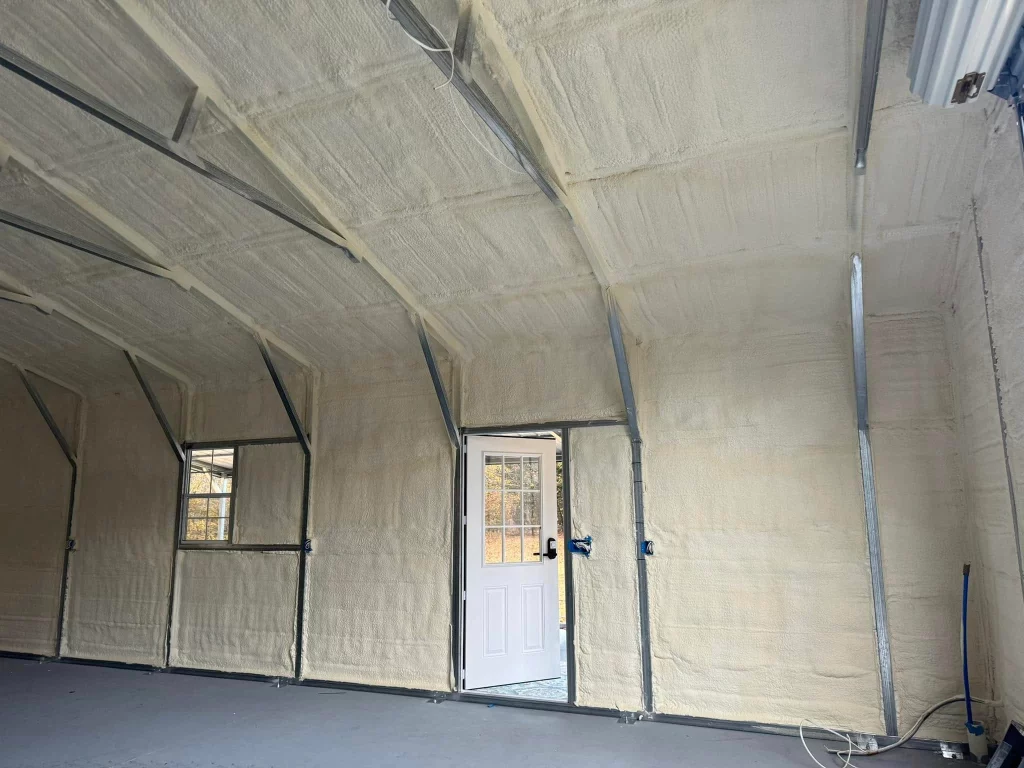
Stored farm equipment represents a significant investment and is highly vulnerable to rust and fluid degradation. Closed-cell spray foam applied to the roof and walls provides the most comprehensive protection by sealing the building envelope completely. If the building will not be heated, local customer ratings can help property owners evaluate insulation contractors before choosing a team to protect agricultural equipment and storage spaces. At minimum, insulate the roof to prevent overhead condensation from dripping directly onto equipment.
Smaller equipment often includes electronics, battery packs, and precision components. Fiberglass batts with a properly sealed vapor barrier can work in this scenario if the building is reasonably airtight. Ensure that stored items are elevated off the floor and that the building has adequate ventilation during humid months.
Materials like lumber, bagged products, and seasonal decorations are vulnerable to mold and warping. Insulation that prevents condensation on walls and roof panels protects these items effectively. Rigid foam board provides good coverage for this use case when budgets are tighter.
Any moisture-sensitive or temperature-sensitive storage demands the highest level of envelope control. Closed-cell spray foam combined with some form of climate control, even a simple dehumidifier, provides the most reliable protection in Stevensville’s mixed-humid climate.
Choosing the right insulation partner and system for your pole barn matters as much as the material itself. Here are indicators that you are on the right track:
Peninsula Insulation, LLC provides professional pole barn insulation services throughout Stevensville and the surrounding Maryland Eastern Shore communities. Our team evaluates your building’s specific conditions, recommends the insulation system that matches your storage needs and budget, and installs it to deliver lasting protection against condensation, temperature swings, and moisture damage. Whether you are storing agricultural equipment, power tools, or sensitive materials, we ensure your building envelope works the way it should.
Request a Quote | Schedule an On-Site Assessment
Call us at (410) 770-2624 or email wil@mdsprayfoam.net to get started. Protecting your stored equipment starts with the right insulation, and we are here to help you get it done correctly the first time.
Uninsulated metal buildings in Stevensville experience heavy condensation, which causes rust on equipment, mold on organic materials, and rapid temperature swings that degrade fluids, batteries, and rubber components.
Roof-only insulation helps with overhead condensation dripping onto equipment, but it leaves walls vulnerable to moisture infiltration and does not provide meaningful temperature stability. For full protection, insulating both roof and walls is recommended.
Yes, insulation reduces heat gain through the roof and walls during summer months, lowering peak interior temperatures and reducing the thermal stress on stored equipment and materials.
Closed-cell spray foam adheres directly to metal surfaces, seals air leaks, and acts as a vapor retarder, which keeps warm, humid air from reaching cold metal panels where condensation would otherwise form.
Ventilation remains important for managing any residual moisture, especially in buildings that store equipment with residual moisture or are not fully sealed. Proper ventilation works alongside insulation, not against it.