What Happens When Traditional Insulation in New Carrollton, MD Leaves Air Gaps?
When traditional insulation in New Carrollton, MD develops air gaps, it stops doing the one job it was installed to…


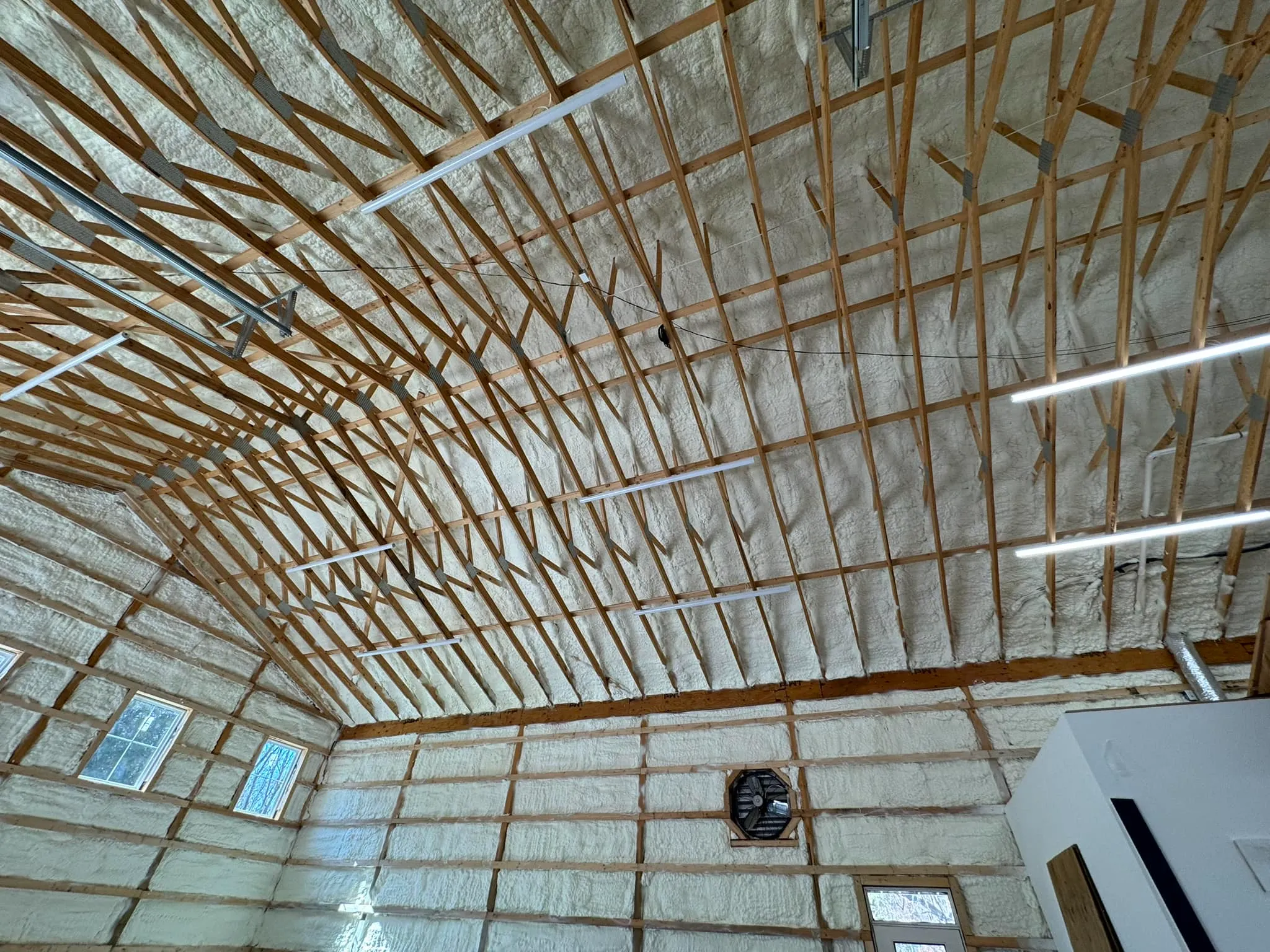
Achieving airtight seals in pole barn insulation across Greensboro, MD, demands a systematic approach built on building science, proper material selection, and precise installation techniques tailored to this region’s specific climate challenges. Greensboro sits squarely in IECC Climate Zone 4A, a mixed-humid zone where buildings face both significant heating loads in winter and heavy moisture in summer. This dual pressure means that pole barn insulation must address thermal resistance and air infiltration simultaneously, and the wrong strategy can lead to condensation, mold, and energy waste. The right approach depends on whether the building is new construction or a retrofit, whether it will be fully conditioned or partially climate-controlled, and what type of interior finish is planned. Closed-cell spray foam, mineral wool batts, fiberglass blankets, and rigid foam board each serve different roles in the assembly, and combining them strategically often yields the best results when following a complete guide to pole barn insulation.
Greensboro, Maryland, located in Caroline County on the Eastern Shore, sits in IECC Climate Zone 4A. This classification means the region experiences cold winters, hot and humid summers, and significant moisture loads year-round. The implications for pole barn insulation are substantial: you need an assembly that handles both heating and cooling demands while controlling moisture migration in both directions.
According to the DOE’s climate zone table, Climate Zone 4 (except Marine) requires a minimum ceiling R-value of R-60 and wall assemblies meeting either R-20 + R5 CI, R-13 + R10 CI, or R-0 + R20 CI. These are prescriptive minimums. For pole barns used as workshops, garages, or living spaces, meeting or exceeding these values directly impacts comfort and energy costs.
Airtightness in post-frame buildings works differently from conventional construction. The building envelope consists of the steel cladding, framing members (columns and girts), insulation layers, vapor control layers, and interior finishes. Each of these must connect continuously to prevent air from bypassing the insulation.
The Building America Solution Center defines an air barrier as “any durable solid material that blocks air flow between conditioned space and unconditioned space, including necessary sealing to block excessive air flow at edges and seams.” For closed-cell spray foam to qualify as an air barrier, it must be at least 1.5 inches thick. Open-cell foam requires a minimum of 5.5 inches. This distinction matters when choosing materials for Greensboro’s climate zone, where both interior and exterior air barriers are required at walls, making proper pole barn insulation material selection critical for long-term performance.
Post-frame buildings with 2×8 bookshelf-style wall girts create deep cavities that accommodate thick insulation while minimizing thermal bridging. In a typical post-frame wall with 3-ply glulam columns and bookshelf girts spaced 24 inches on center, less than 6% of the wall area has wood touching both the exterior and interior surfaces. Standard stick-frame construction often exceeds 15%. This means more of your insulation actually performs at its rated R-value.
| Material | R-Value Per Inch | Air Seal Capability | Moisture Resistance | Best Application |
|---|---|---|---|---|
| Closed-Cell Spray Foam | R-5.1 to R-6.0 | Excellent (air + vapor barrier at 1.5″) | Excellent | Walls, rim areas, steel-to-wood transitions |
| Open-Cell Spray Foam | ~R-3.8 | Good (air barrier at 5.5″) | Low (vapor open) | Interior cavities, sound-dampening |
| Mineral Wool Batts | ~R-4.2 | Low (needs a separate air barrier) | High (repels water) | Wall cavities with a separate air barrier |
| Fiberglass Batts | ~R-3.1 to R-3.4 | Low (needs a separate air barrier) | Low | Budget wall cavity fill |
| Rigid Foam Board | R-3.8 to R-6.5 | Good (when seams taped) | Good | Continuous insulation, slab perimeter |
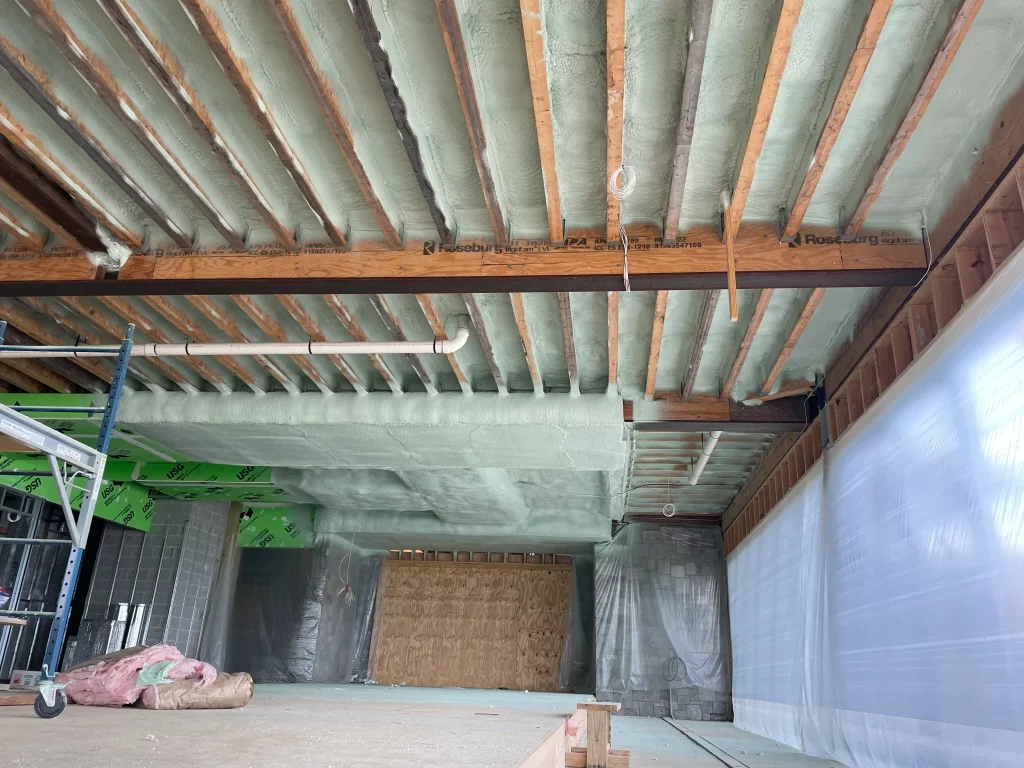
Before any material goes up, our team maps the complete thermal envelope. We identify where the air barrier will run continuously across walls, ceiling, and foundation connections. In Climate Zone 4A, this means planning for an interior air barrier at walls and ceiling, plus an exterior drainage plane behind the steel cladding as part of a high-performance spray foam insulation Greensboro, MD installation strategy.
Key planning decisions include:
The slab-to-wall connection is one of the most vulnerable points for air infiltration. We seal all penetrations through the concrete and ensure the vapor retarder over exposed ground in crawl spaces overlaps by 6 inches minimum with sealed joints. Slab edge insulation must be continuous, and any plumbing or electrical penetrations through the slab must be sealed with appropriate caulk or spray foam.
For Greensboro’s Zone 4A, our recommended wall assembly from outside to inside:
When using spray foam directly against metal panels, we follow guidance from the Frame Building News technical article on post-frame insulation regarding oil canning prevention: applying a thin flash coat with picture framing technique on large unsupported panels avoids visible distortion in the steel.
In Climate Zone 4A, the ceiling air barrier must align with the interior horizontal surface. We use raised heel trusses that are at least one inch taller than the planned insulation depth, allowing full R-value at the eaves. Vented eaves and a vented ridge allow any moisture that enters the attic space to escape. A continuous air barrier at the ceiling plane, whether through spray foam, taped drywall, or sealed rigid board, prevents warm interior air from reaching cold attic surfaces where it could condense.
Skipping the air barrier behind fiberglass or mineral wool. Batt insulation alone does not stop air movement. Without a continuous air barrier in full contact with the insulation, air washes through the cavity, reducing effective R-value by 30% or more.
Placing rigid foam board between the framing and the steel cladding. This reduces or eliminates the shear strength of the steel panels. Rigid foam should go on the interior side of framing or as continuous insulation outside the framing, but behind properly attached cladding.
Using cellulose insulation directly against steel panels. The hygroscopic fire retardants in cellulose can retain moisture against steel, promoting corrosion over time. Mineral wool or fiberglass is a safer choice for cavity fill in steel-clad buildings.
Failing to seal penetrations. Every electrical box, plumbing penetration, HVAC boot, and structural connection that passes through the thermal envelope needs to be sealed with caulk, spray foam, or gaskets. The air barrier must be continuous, not mostly continuous.
| Building Use | Recommended Approach | Key Notes |
|---|---|---|
| Cold Storage / Agricultural | Closed-cell spray foam on walls and roof deck | Controls condensation; no interior finish needed |
| Workshop / Garage (heated) | Spray foam air seal + mineral wool batts + vapor barrier | Interior finish protects insulation, balanced cost |
| Residential / Barndominium | Full spray foam envelope + interior drywall | Must meet the full IRC Chapter 11 energy code |
| Retail / Commercial | Closed-cell foam at steel + batt cavity fill + continuous interior air barrier | Code compliance required, fire-rated assemblies |
At Peninsula Insulation, LLC, we specialize in designing and installing airtight insulation systems for pole barns and post-frame buildings across Greensboro, MD, and the surrounding Eastern Shore. Our team understands the specific demands of Climate Zone 4A and builds assemblies that perform season after season. Whether you are planning new construction or upgrading an existing pole barn, we bring the technical expertise to get the seal right the first time.
Request a Quote | Schedule a Building Assessment
Contact us at (410) 770-2624 or email wil@mdsprayfoam.net to discuss your project. Every pole barn deserves an insulation system built on building science, not guesswork.
Greensboro falls in Climate Zone 4A, which requires wall assemblies meeting R-20 + R5 continuous insulation or equivalent combinations like R-13 + R10 CI per the 2021 IECC. For conditioned residential pole barns, these are minimums.
Yes. Closed-cell spray foam at a minimum thickness of 1.5 inches functions as an air barrier, vapor barrier, and thermal insulation simultaneously, according to the Building America Solution Center.
Warm, moist interior air contacting cold steel surfaces during winter causes condensation, which leads to corrosion, mold growth, and insulation degradation. Proper air sealing, vapor barriers, and adequate insulation thickness prevent this.
Existing pole barns can be retrofitted with spray foam, blown-in insulation, or batt insulation. However, achieving a continuous air barrier is more challenging in retrofits and requires careful attention to existing penetrations and framing conditions.
Post-frame buildings with bookshelf girts have less than 6% of the wall area where wood spans from exterior to interior, compared to roughly 15% or more in standard stick-frame walls. This means significantly less heat loss through framing members.