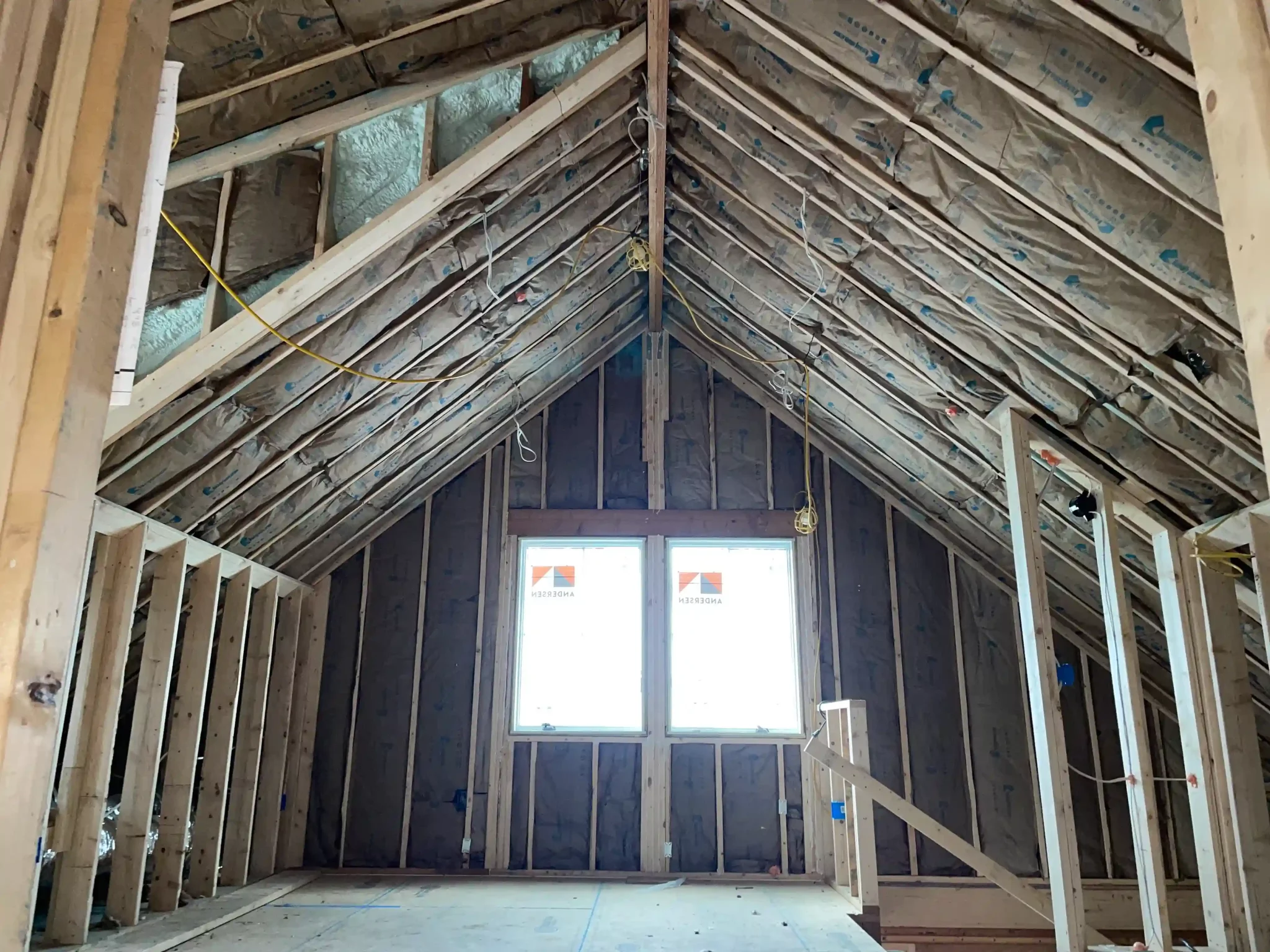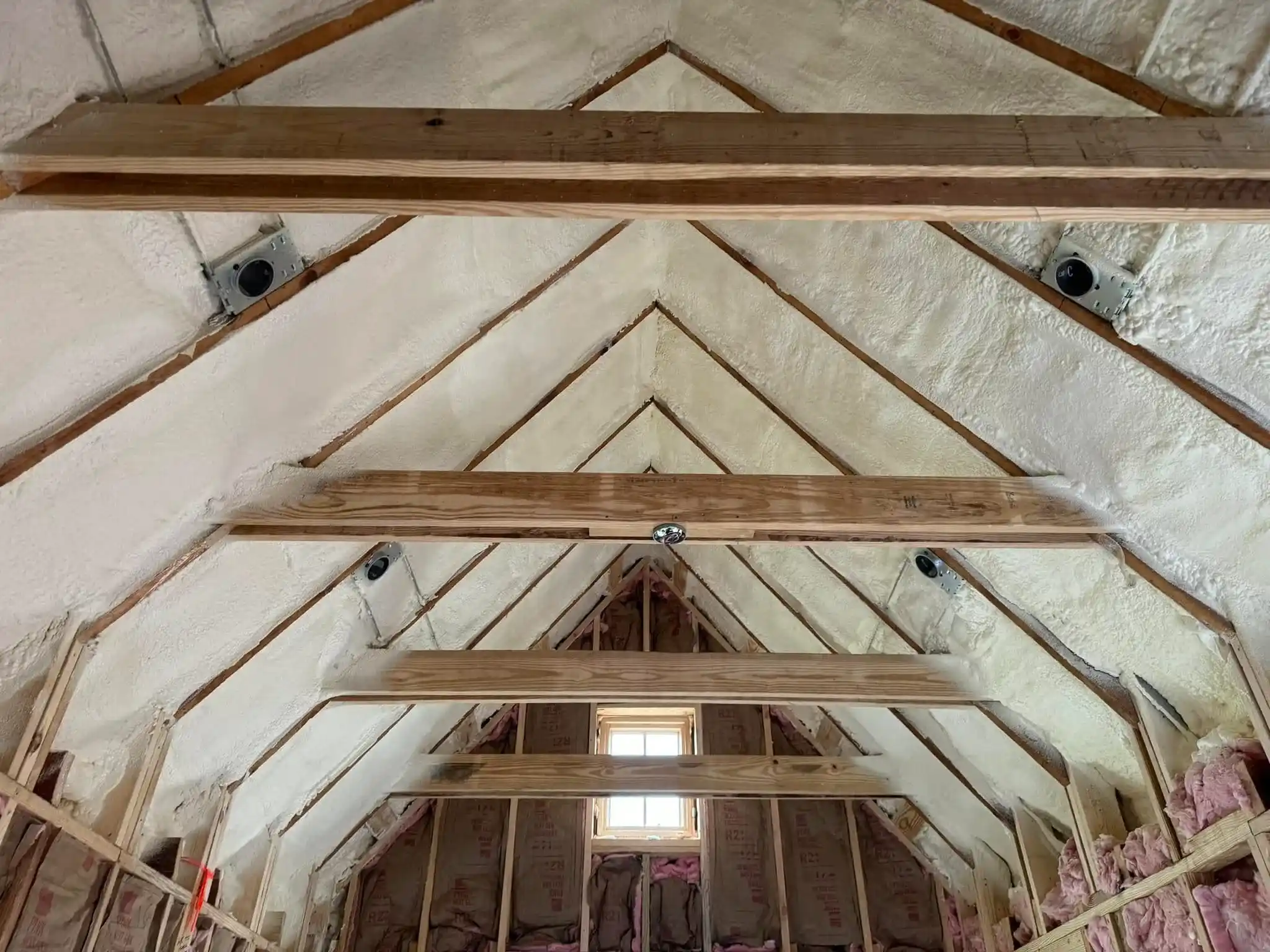
What Happens When Traditional Insulation in New Carrollton, MD Leaves Air Gaps?
When traditional insulation in New Carrollton, MD develops air gaps, it stops doing the one job it was installed to…


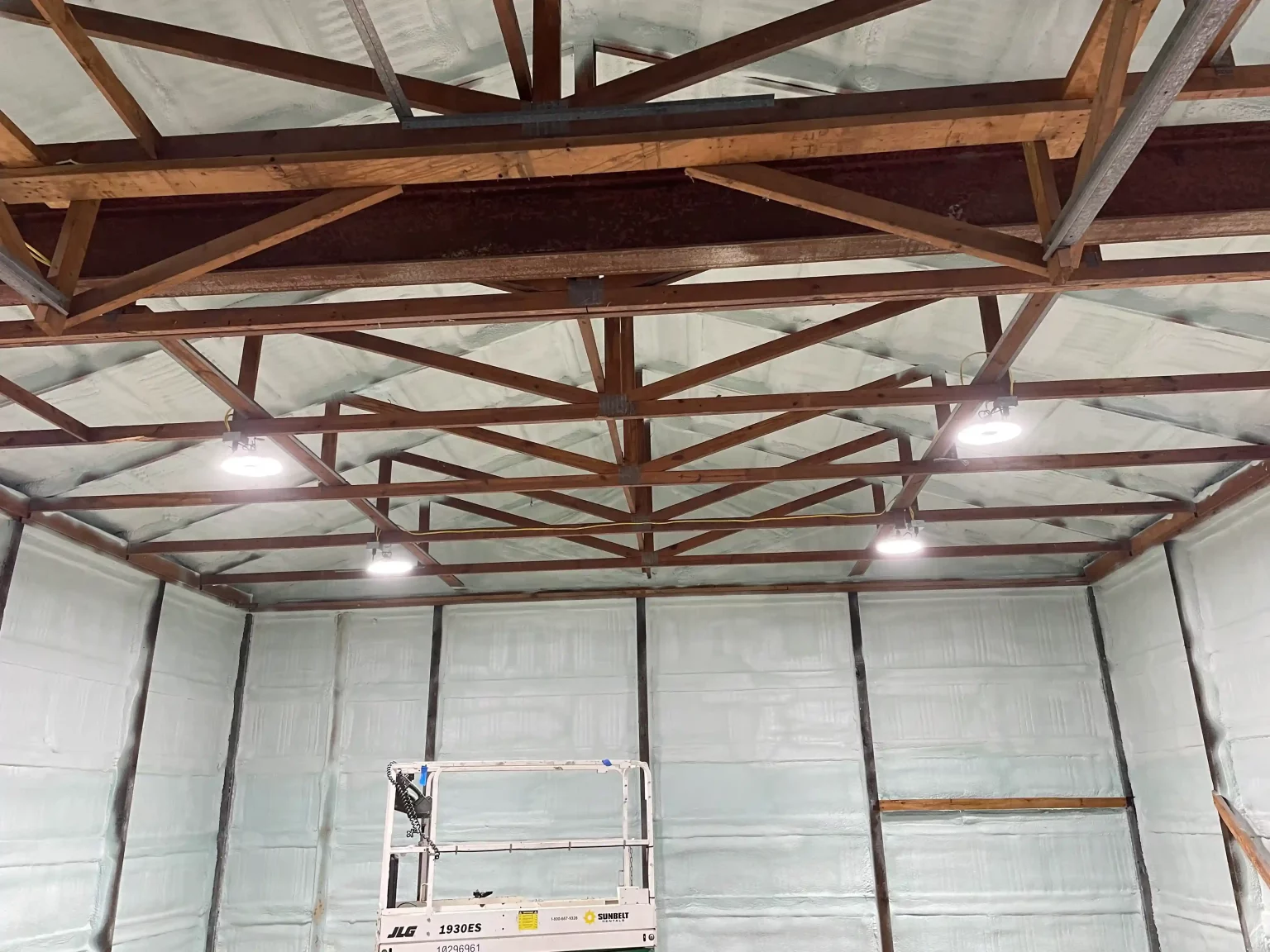
Choosing the best insulation for pole barn construction is not a one-size-fits-all decision. It depends on your building’s intended use, local climate, moisture exposure, and long-term energy goals. For a full overview of how pole barns lose heat and where to prioritize insulation, see our pole barn insulation guide, which this article builds on with a closer look at material selection. The main pole barn insulation options include fiberglass batts, spray foam (open-cell and closed-cell), and foam board, and each one delivers a different balance of R-value, air sealing, and moisture resistance. This guide walks through how those materials compare so you can match the right one to your project.
Pole barns present different challenges than stick-built structures. Wide column spacing, exposed metal panels, and open cavities let heat move freely through conduction, convection, and radiation. Metal roofing and siding also create a real condensation risk, especially where daytime and nighttime temperatures swing widely.
Heat naturally flows from warmer areas to cooler ones, and in a pole barn, that transfer happens quickly through bare metal. Without an effective thermal barrier, heating and cooling equipment works harder and energy costs climb. Pole barns also lack the thermal mass of conventional framing, and the posts and girts common in post-frame construction create thermal bridging points where heat bypasses the insulation entirely. That is why comparing pole barn insulation options on air sealing, not just R-value, matters so much.
| Material | R-Value Per Inch | Air Sealing | Moisture Resistance | Best Application |
| Fiberglass Batts | R-2.2 to R-3.5 | Low, gaps common | Low, absorbs moisture | Budget projects, standard wall cavities |
| Open-Cell Spray Foam | R-3.4 to R-3.8 | High, expands to fill | Moderate, vapor permeable | Interior walls, sound dampening |
| Closed-Cell Spray Foam | R-5.1 to R-6.7 | Excellent, airtight | Excellent, acts as vapor barrier | Roofs, metal walls, condensation-prone areas |
| Foam Board (Polyiso) | R-5.6 to R-7.0 | Moderate, seams need taping | High, closed-cell structure | Continuous insulation, tight cavities |
Fiberglass remains the most widely used material in pole barn construction because of its lower cost and simple installation. It is manufactured from fine glass fibers and sold as batts, rolls, or loose fill, and higher-density versions offer slightly better R-value per inch.
The tradeoff is performance. Fiberglass does not air seal on its own, so gaps between batts and framing allow convective heat loss, and compressing it into tight spaces reduces its rated R-value. In a pole barn with a metal interior, fiberglass also needs a separate vapor barrier to keep condensation from soaking the material.
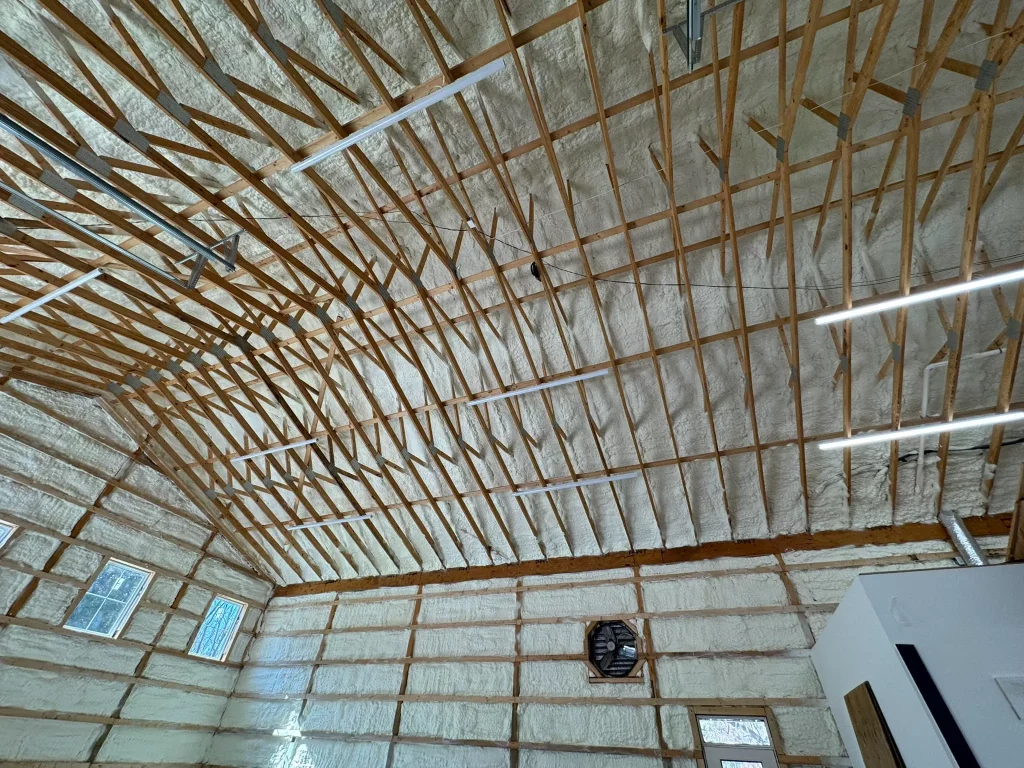
Spray polyurethane foam comes in two types, low-density open-cell and medium-density closed-cell, and it has become the standard choice for higher-performance pole barn projects. For property owners weighing this against foam board, our closed-cell spray foam insulation service page covers application details and pricing factors specific to metal-frame buildings.
Closed-cell spray foam is the strongest performer of the group. At a minimum thickness of about 50 mm, it works as both an air barrier and a vapor barrier, and it bonds to framing and metal surfaces well enough to add structural rigidity. It expands to fill gaps, cracks, and irregular surfaces, creating a continuous thermal envelope that fiberglass cannot match, which is especially useful where metal panels meet wood framing at odd angles.
Open-cell spray foam costs less per board foot and still air seals well, with R-values around R-3.8 per inch. It expands significantly during application and fills large cavities efficiently, but it is vapor-permeable, so it does not block moisture on its own. In a pole barn with heavy condensation risk, open-cell foam often needs a supplementary vapor barrier.
Foam board, particularly polyisocyanurate (polyiso), delivers a high R-value in a thin profile. It is available as rigid board, sprayed foam, and laminated panels with various facings, and foil-faced polyiso can also act as a radiant barrier when installed with an adjacent air space.
In pole barns, foam board is commonly installed as continuous insulation over girts and purlins, which breaks the thermal bridging that happens at framing contact points. The main limitation is that seams must be carefully taped and sealed, or the system loses much of its air-sealing advantage.
| Pole Barn Use | Recommended Approach | Key Consideration |
| Livestock or agricultural storage | Closed-cell spray foam on walls and roof | Humidity and ammonia exposure require moisture-proof insulation |
| Workshop or garage | Closed-cell spray foam or foam board with taped seams | Temperature control and condensation prevention on metal |
| Residential or finished space (barndominium) | Closed-cell spray foam plus foam board continuous insulation | Must meet residential code R-value requirements |
| Cold storage or seasonal use | Fiberglass batts with a vapor barrier, or foam board | Budget-sensitive, less demanding thermal target |
Building codes divide the country into climate zones, each with its own minimum R-value requirement, and those numbers set the floor for any material comparison. In warmer regions (Zones 1 through 3), ceiling R-values of R-30 to R-49 are typical, and 5 to 6 inches of closed-cell spray foam can hit that target while providing the air and vapor sealing a metal building needs. In colder regions (Zones 4 through 8), ceiling requirements climb toward R-60, which usually calls for either a thick spray foam application or a layered system that combines foam board with spray foam or fiberglass to reach the target cost-effectively. The current code requirements are published by the International Code Council in the IECC.
Prioritizing R-value alone. A high R-value means little if air leaks through gaps in the insulation. A well-sealed system often outperforms a higher-R fiberglass installation with hidden gaps.
Ignoring condensation. Uninsulated metal roofs are prone to dripping condensation that damages contents and degrades building materials over time. Closed-cell spray foam applied to the roof deck keeps the interior surface above the dew point and removes the problem at its source.
Compressing insulation. Compressed insulation does not deliver its full rated R-value, which is a common mistake when batts are forced into cavities that are too shallow.
Skipping professional installation. Spray foam and foam board systems both require precise application. Improperly installed foam can shrink, off-gas, or fail to cure correctly, which cuts into both performance and safety.
For a deeper look at how different materials handle moisture over time, see our complete guide to mineral wool insulation, which compares fire resistance and sound dampening against the options covered here.
Choosing between fiberglass, spray foam, and foam board depends on details specific to your building, your climate zone, and how you plan to use the space. Our team can walk through those factors with you and recommend a system built for long-term performance. Get a free quote or contact us to get started.
Closed-cell spray foam is generally considered the best insulation for pole barn buildings because it combines a high R-value with complete air sealing and vapor barrier performance in one material. Foam board is a strong alternative for continuous insulation over framing, and fiberglass batts remain the most budget-friendly option for less demanding applications.
The right R-value depends on your climate zone, building use, and whether the space is heated or cooled. Code minimums for ceilings range from around R-30 in warmer zones up to R-60 in the coldest zones, and conditioned living spaces require higher values than unheated storage buildings.
Yes. Foam board delivers a high R-value in a thin profile and works well as continuous insulation over girts and purlins, which helps break thermal bridging. Seams need to be taped and sealed carefully, or the system loses much of its air-sealing benefit.
Both new and existing pole barns can be insulated effectively. Spray foam is particularly well suited to retrofit projects because it adheres to existing metal surfaces and expands to fill irregular cavities without requiring demolition of interior finishes.
A vapor barrier, or a material like closed-cell spray foam that acts as one, keeps warm, moist air from reaching cold metal surfaces where it would otherwise condense. This stops dripping, mold growth, and material degradation before they start.
Some insulation upgrades that meet current energy code requirements may qualify for federal tax credits on the building envelope. Eligibility depends on the specific materials and installation, so it is worth confirming details with a tax professional for your project.
ENERGY STAR Insulation Fact Sheet, for R-value definitions and installation best practices.
International Code Council, 2021 IECC Residential Energy Efficiency Chapter, for current climate zone R-value requirements.