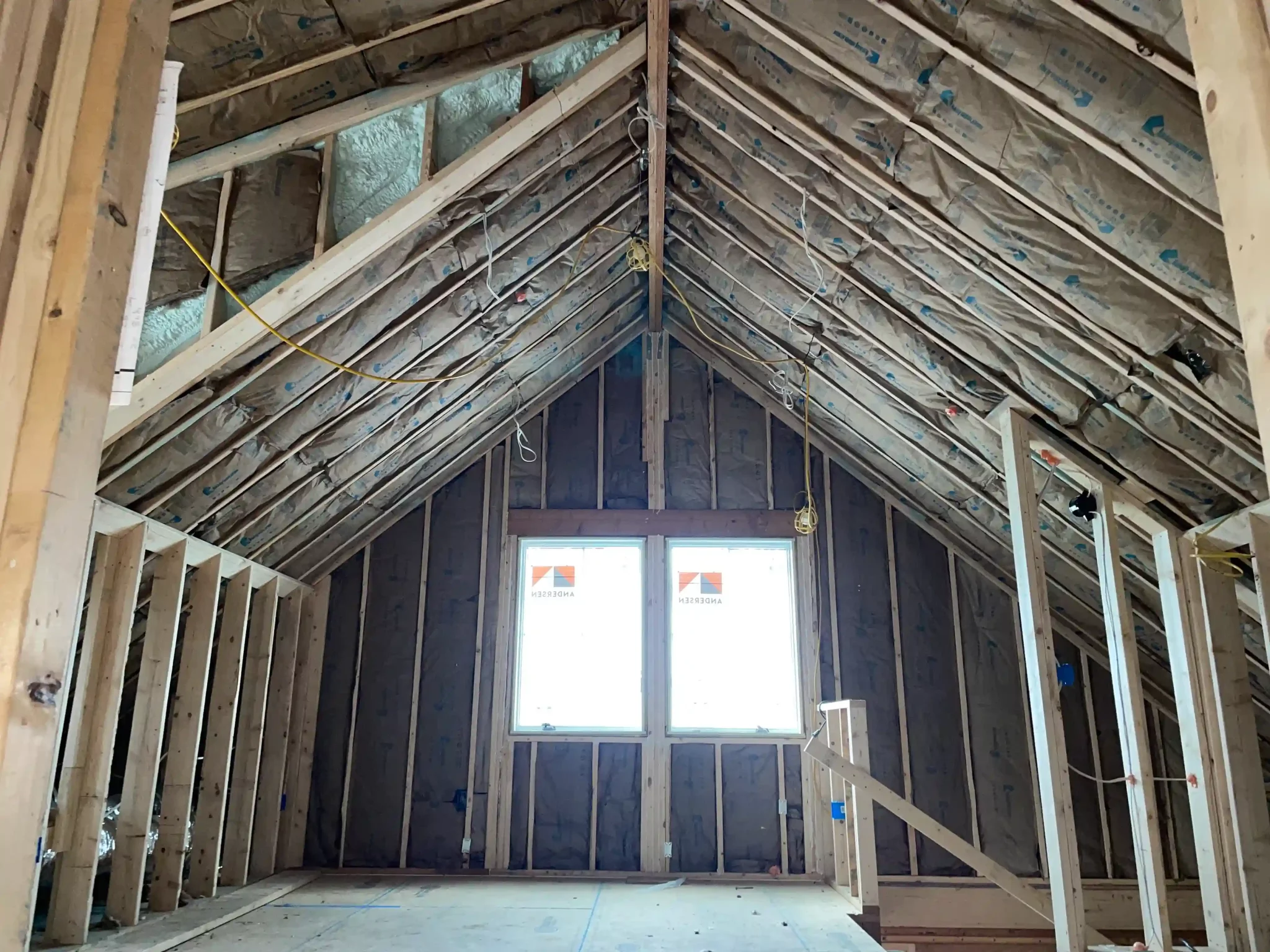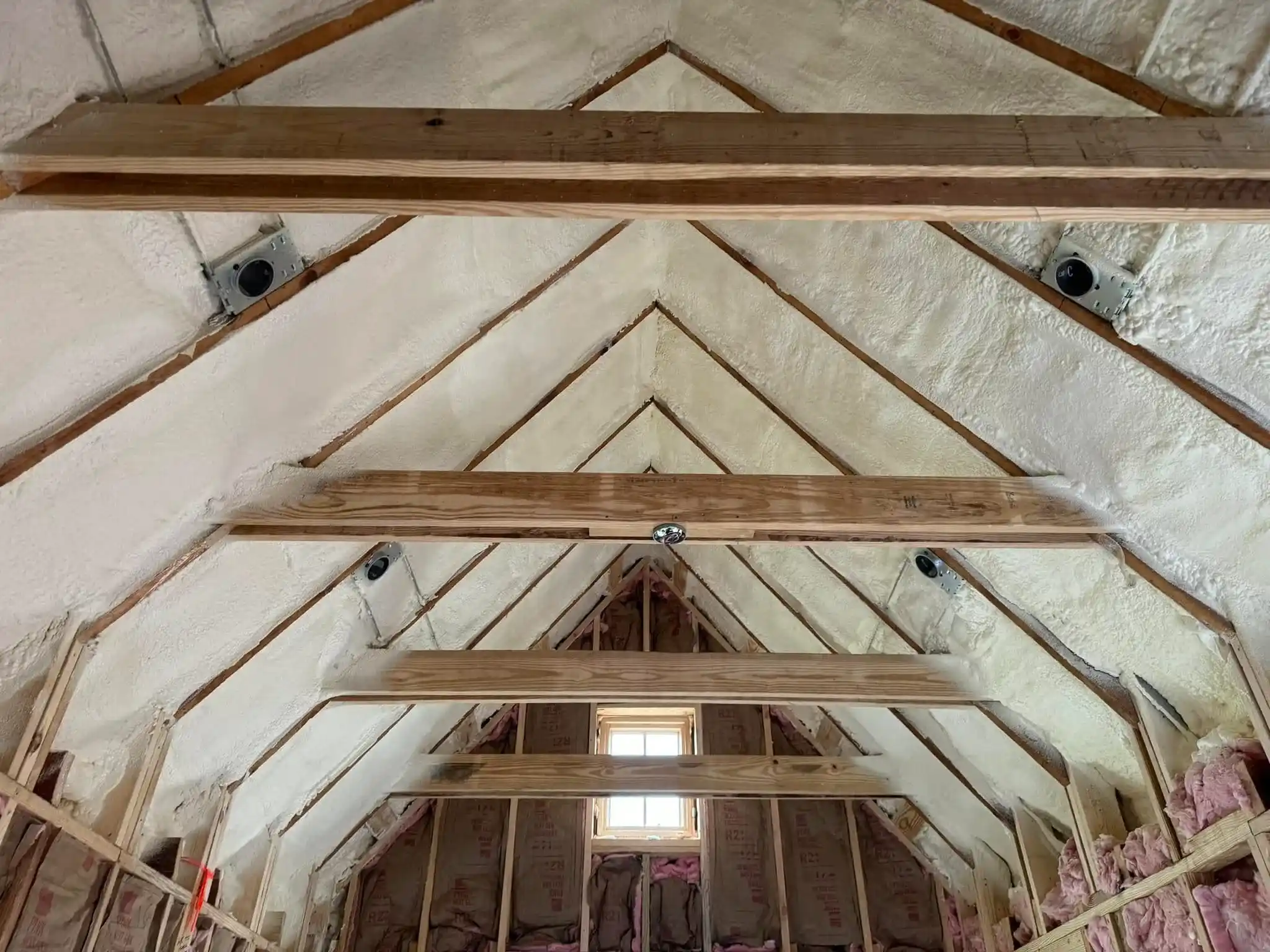
What Happens When Traditional Insulation in New Carrollton, MD Leaves Air Gaps?
When traditional insulation in New Carrollton, MD develops air gaps, it stops doing the one job it was installed to…


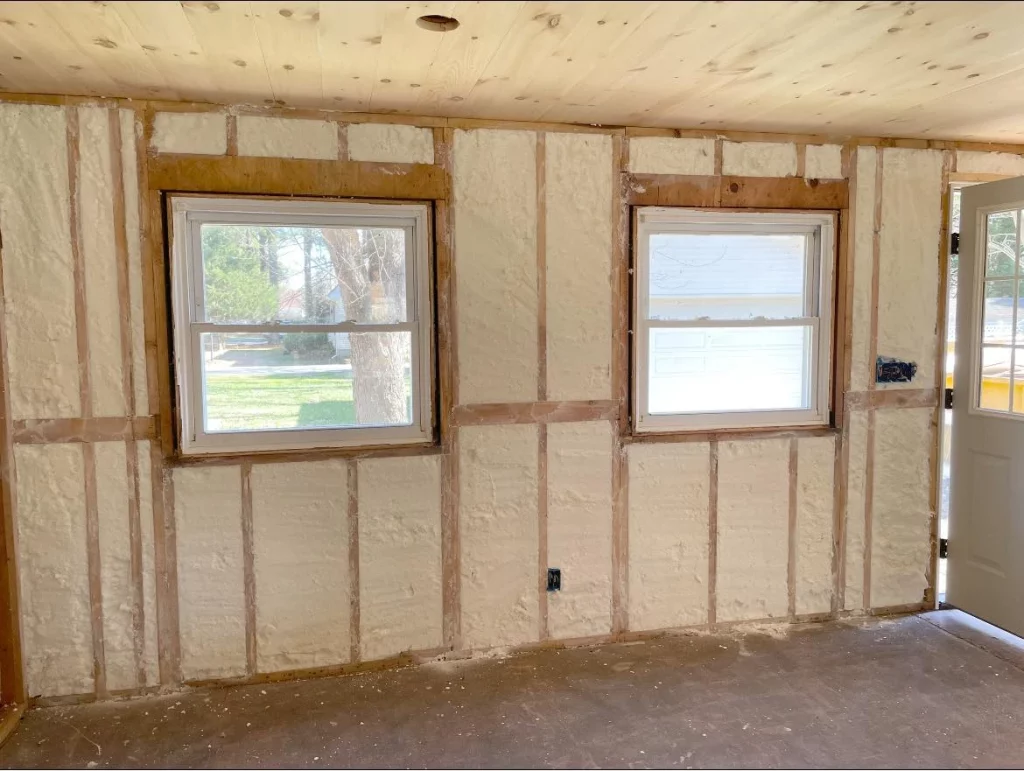
Closed-cell spray foam delivers a combination of moisture resistance, high thermal performance, and structural reinforcement that makes it a strong insulation choice for homes in Hebron, MD, where the local climate creates persistent moisture challenges. Located in IECC Climate Zone 4A (mixed-humid), Wicomico County experiences high atmospheric humidity, heavy seasonal precipitation, and warm summer temperatures that push water vapor into wall cavities, crawl spaces, and attics. For homeowners dealing with damp basements, musty crawl spaces, or condensation issues, the right insulation depends on factors like foundation type, cavity depth, and existing moisture sources. Closed-cell spray foam, open-cell spray foam, and hybrid approaches each serve different purposes, but closed-cell stands apart in moisture-heavy environments because it acts simultaneously as an air barrier, vapor retarder, and thermal insulator. These properties contribute to closed-cell foam longevity, making it especially valuable in moisture-prone environments.
Hebron falls within Maryland’s Climate Division 1, the Southeastern Shore, which the Maryland State Climatologist’s Office describes as a region of high atmospheric humidity influenced by the Atlantic coastal area. Summers bring warm to hot conditions with humidity that makes the heat more oppressive, while spring and fall produce rapid weather changes with frequent cyclonic activity. Precipitation across the Eastern Shore averages between 40 and 48 inches annually, with summer months delivering four to five and a half inches per month during the peak thunderstorm season.
This combination of heat and humidity means water vapor is constantly seeking ways into your home. When warm, moist air contacts cooler surfaces inside wall cavities, crawl spaces, or attic assemblies, condensation forms. The U.S. Department of Energy explains that insulation moderates heat transfer across building cavities, but in humid climates, the insulation itself must also resist moisture accumulation to prevent the very problems it is meant to solve.
Homes in Hebron with basements, crawl spaces, or rim joist areas are especially vulnerable. Below-grade foundations contact soil moisture year-round, and vented crawl spaces pull humid outdoor air directly into floor assemblies during summer months. Without proper vapor control, this moisture leads to mold growth, wood rot, and degraded indoor air quality.
Closed-cell spray polyurethane foam is applied as a liquid that expands and cures into a dense, rigid material with sealed gas-filled cells. This cellular structure gives it three properties that matter in moisture-prone homes. Understanding open-cell vs closed-cell durability helps homeowners choose the right insulation for long-term performance.
Thermal performance. Closed-cell spray foam delivers R-6 to R-7 per inch of thickness, substantially higher than fiberglass batts (R-2.9 to R-3.8 per inch) or open-cell spray foam (R-3.5 to R-3.6 per inch). In a 2×4 wall cavity measuring only 3.5 inches deep, closed-cell foam can achieve approximately R-21 to R-25 without needing thicker framing. This matters in older Hebron homes where wall cavities may be shallow.
Vapor retarder capability. According to the Building Science Corporation’s Residential Spray Foam Guide, high-density closed-cell spray foam acts as a code-prescribed Class II vapor retarder at 1.5 inches of thickness, as specified in the International Residential Code section R702.7 for Climate Zones 4 through 8. A Class II vapor retarder has a permeance rating of 1.0 perm or less, meaning it substantially blocks the diffusion of water vapor through the assembly.
Air sealing. Spray foam adheres to substrates and expands into gaps, cracks, and penetrations that other insulation types cannot reach. This continuity eliminates air leakage pathways that carry moisture-laden air into cavities. The Building Science Corporation notes that spray foam provides continuity of water control, air control, vapor control, and thermal control layers in a single application.
Not every area of your home requires closed-cell spray foam, but several locations in moisture-prone Hebron homes benefit significantly from it.
The Building Science Corporation is explicit on this point: vented crawl spaces must keep air and vapor out of the floor framing, and only high-density closed-cell spray foam should be used in all IECC climate zones for this application. Vented crawl spaces in mixed-humid climates pull warm, humid outdoor air into the cool floor assembly above, creating condensation on joists, subflooring, and ductwork. Closed-cell foam applied to the rim joist and floor cavity underside blocks both air infiltration and vapor diffusion.
For conditioned (sealed) crawl spaces, closed-cell foam on foundation walls provides insulation and a capillary break between the masonry and interior finishes.
Below-grade basement walls are in direct contact with damp soil. The EPA’s Moisture Control Guidance recommends using moisture-resistant insulation against the interior side of basement walls to keep warm, humid interior air away from cool foundation surfaces. Closed-cell spray foam applied directly to concrete or masonry basement walls provides this separation while also adding R-value and acting as a vapor retarder. In Climate Zones 4 and above, high-density closed-cell foam is the preferred material for basement wall insulation.
The rim joist area, where the floor framing meets the foundation, is one of the most leaky and condensation-prone locations in any home. Gaps around framing members, plumbing penetrations, and wiring create air leakage pathways. Closed-cell foam seals these penetrations completely and provides sufficient R-value in the limited depth available. Homeowners often rely on a trusted spray foam contractor in Hebron, MD, to address these critical areas and improve overall energy performance.
For unvented conditioned attics in Climate Zone 4A, both open-cell and closed-cell spray foam can be installed directly to the underside of the roof deck. However, closed-cell foam provides the additional benefit of vapor control at the roof plane, which is important in mixed-humid climates where humid indoor air can otherwise reach the cold roof sheathing and condense. The Building Science Corporation recommends closed-cell spray foam for unvented attics in Climate Zones 5 and higher, and its vapor control properties remain beneficial in Zone 4A as well.
| Feature | Closed-Cell Spray Foam | Open-Cell Spray Foam |
|---|---|---|
| R-Value Per Inch | R-6 to R-7 | R-3.5 to R-3.6 |
| Vapor Permeability | Low (Class II vapor retarder at 1.5″) | High (vapor-open, greater than 10 perms) |
| Density | High (rigid, structural) | Low (flexible, lightweight) |
| Moisture Resistance | Resists water absorption and vapor transmission | Absorbs and holds water; does not block vapor |
| Air Sealing | Air-impermeable insulation | Air-impermeable insulation |
| Best Applications | Crawl spaces, basements, rim joists, thin cavities | Large wall cavities, interior partitions, sound control |
| Code Compliance for Vented Crawl Spaces | Approved for all climate zones | Not approved for vented crawl spaces |
In moisture-prone homes, open-cell foam’s high permeability means it cannot stop vapor from passing through the insulation and condensing on cooler surfaces deeper in the assembly. While open-cell foam provides excellent air sealing and sound attenuation, it requires a separate vapor retarder and is not appropriate for below-grade or vented crawl space applications.
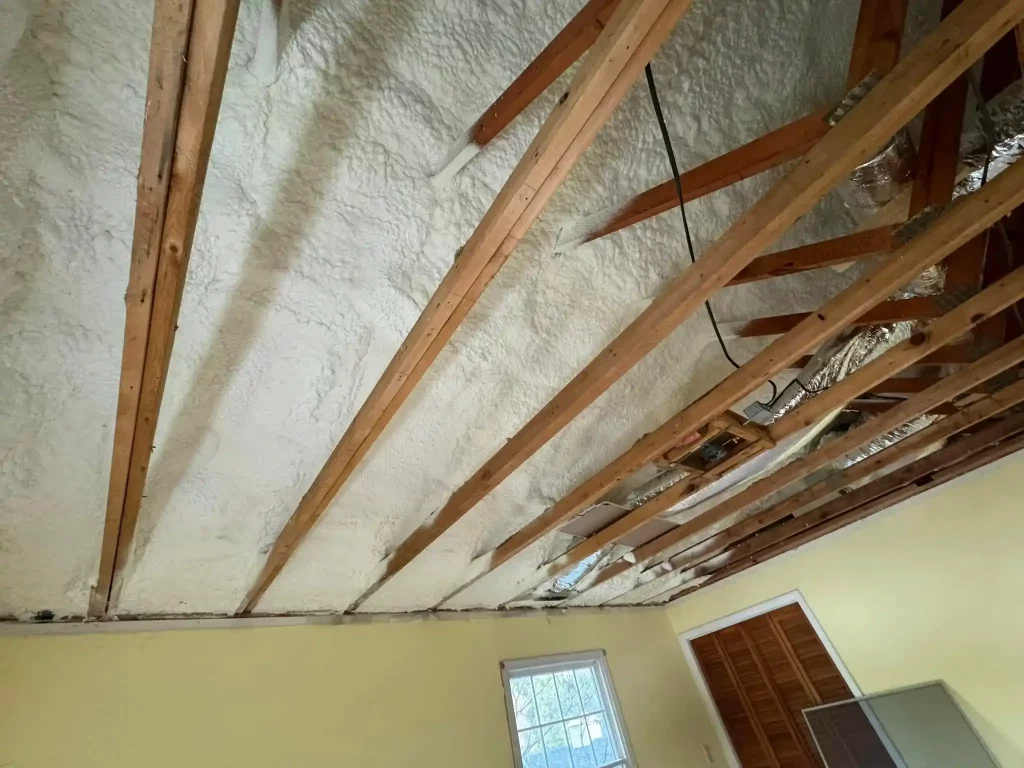
The EPA’s guide to mold and moisture states clearly that moisture control is the key to mold control. Mold spores are present virtually everywhere indoors and outdoors, but they cannot grow without moisture. When insulation fails to control condensation and vapor diffusion, moisture accumulates on organic building materials like wood framing, drywall paper facing, and oriented strand board. The EPA notes that damp indoor environments are associated with upper respiratory symptoms, coughing, wheezing, and asthma exacerbation.
The EPA further estimates that 4.6 million cases of asthma in the United States, roughly 21 percent of all cases, can be attributed to exposure to dampness and mold in homes. Lawrence Berkeley National Laboratory research cited by the EPA found that building dampness and mold raise the risk of respiratory and asthma-related health effects by 30 to 50 percent.
Closed-cell spray foam addresses this risk at the source. By blocking vapor diffusion and air leakage simultaneously, it keeps wall cavities, crawl spaces, and attic assemblies dry enough to prevent mold growth on structural materials.
| Home Type | Moisture Risk Level | Recommended Approach | Key Notes |
|---|---|---|---|
| Older home with a vented crawl space | High | Closed-cell foam on rim joist and floor cavity; consider crawl space encapsulation | Vented crawl spaces in humid climates need a full vapor and air barrier |
| Home with unfinished basement | High | Closed-cell foam on the basement walls and rim joist | Provides insulation, vapor retarder, and air seal in one step |
| New construction with conditioned crawl space | Moderate | Closed-cell foam on foundation walls with a sealed vapor barrier on the floor | Combines insulation with moisture control for the entire assembly |
| Home with an unvented attic | Moderate | Closed-cell foam on the roof deck underside | Superior to open-cell in mixed-humid climates due to vapor control |
| Home with standard wall cavities (no moisture issues) | Low | Closed-cell or open-cell foam, or a hybrid with fiberglass | Both foam types work; closed-cell provides added moisture protection |
Choosing the right installer matters as much as choosing the right material. A qualified spray foam contractor will:
Peninsula Insulation, LLC provides professional spray foam insulation services for homeowners throughout Hebron and the surrounding Wicomico County area. Our team evaluates your home’s specific moisture challenges and recommends the right insulation strategy for each area of your building envelope, from crawl spaces and basements to attics and wall assemblies. We work exclusively with closed-cell and open-cell spray foam products that meet IRC and IECC code requirements for Climate Zone 4A.
Request a Quote | Schedule a Moisture Assessment
Call us at (410) 770-2624 or email wil@mdsprayfoam.net to discuss your insulation needs with our experienced team.
Yes, but active water leaks and drainage issues should be resolved before insulation is installed. Closed-cell foam controls vapor diffusion and air leakage, but it is not a substitute for fixing plumbing leaks or grading problems that send liquid water into the building.
Closed-cell spray foam achieves Class II vapor retarder classification at approximately 1.5 inches of thickness, according to IRC section R702.7. Your installer can confirm the specific thickness required for your assembly and climate zone.
It depends on the attic configuration. For vented attics with existing fiberglass, closed-cell foam applied at the ceiling plane can seal air leakage pathways that fiberglass cannot address. For unvented conditioned attics, spray foam applied to the roof deck underside replaces the need for ventilation and attic-floor insulation entirely.
No insulation material can guarantee mold prevention. Mold requires moisture, and closed-cell foam significantly reduces the risk by blocking vapor diffusion and air leakage. The EPA recommends maintaining indoor relative humidity between 30 and 50 percent as an additional measure.
For vented crawl spaces, building science guidance specifies closed-cell spray foam exclusively across all climate zones. Open-cell foam is vapor-permeable and cannot prevent moisture from passing through into the floor assembly. For conditioned, sealed crawl spaces, closed-cell foam on foundation walls remains the preferred approach.