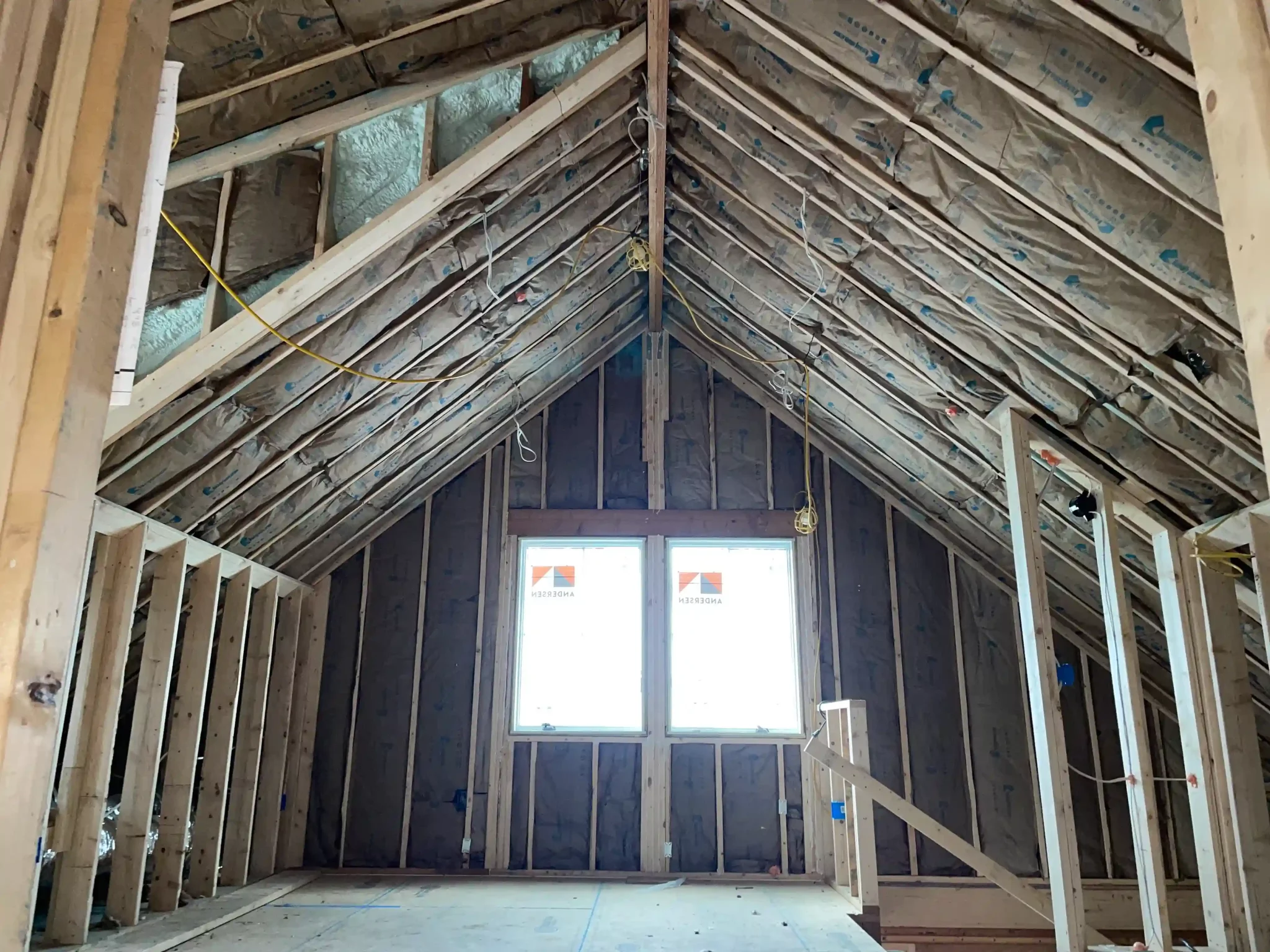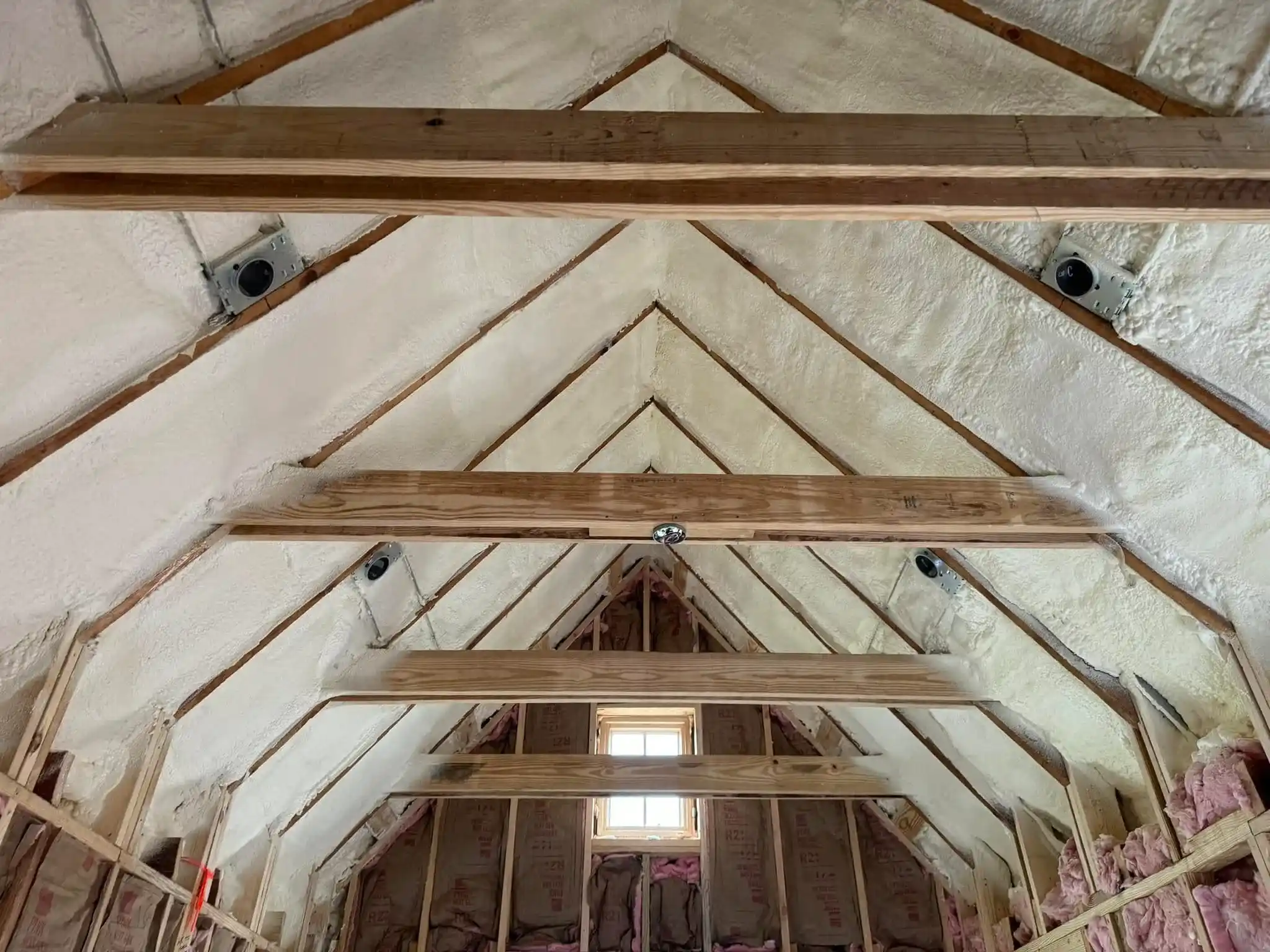
What Happens When Traditional Insulation in New Carrollton, MD Leaves Air Gaps?
When traditional insulation in New Carrollton, MD develops air gaps, it stops doing the one job it was installed to…


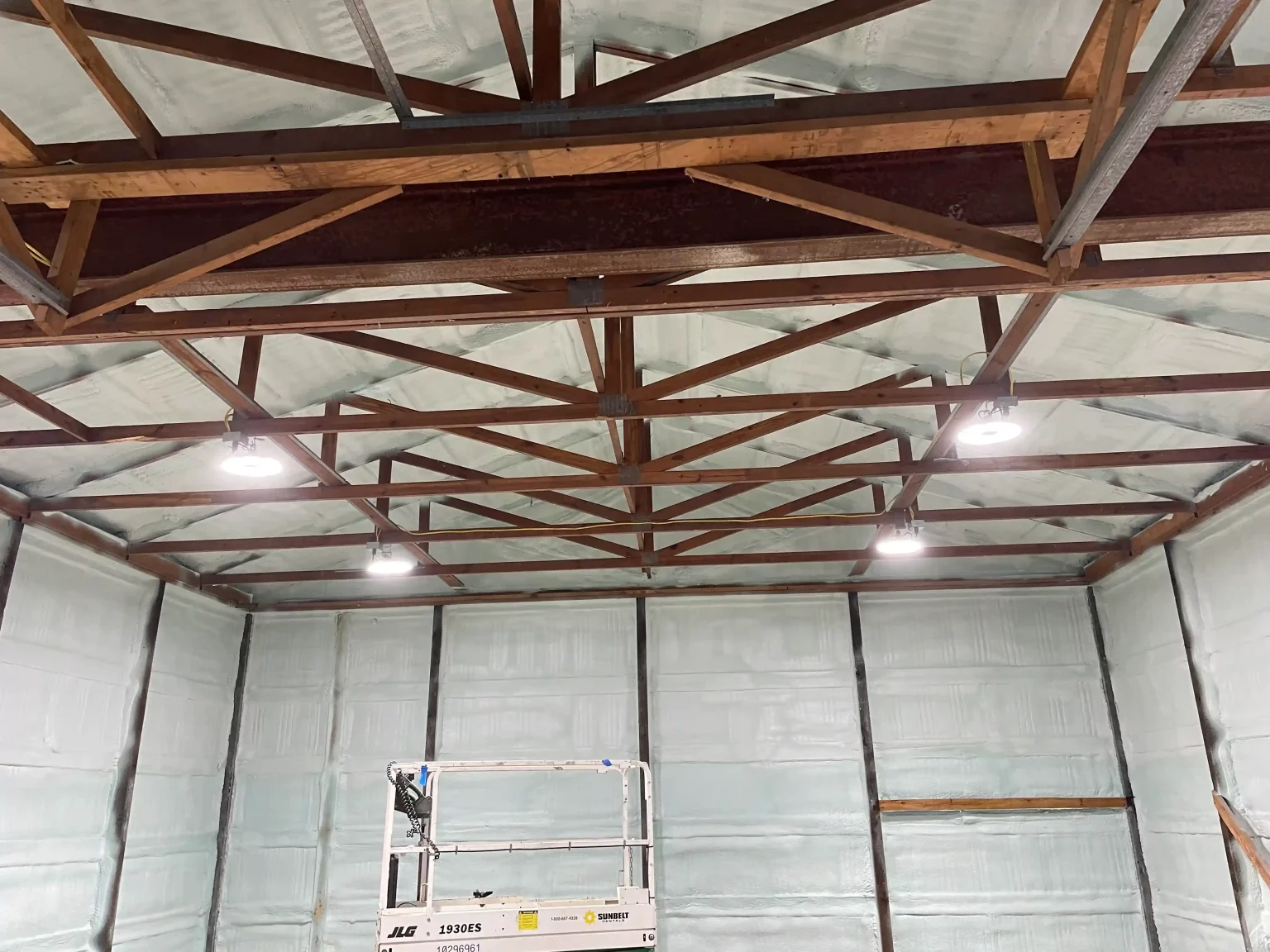
Pole barn insulation prevents condensation and moisture damage by keeping interior surface temperatures above the dew point of the air inside the building, blocking the air leakage that carries water vapor through walls and roofs, and creating a continuous vapor barrier that stops moisture diffusion. In Edgewater, Maryland, which sits in IECC Climate Zone 4, the combination of cold winters and humid summers makes pole barns especially prone to condensation on metal roofing and siding. Closed-cell spray foam insulation directly addresses all three problems, condensation, moisture damage, and energy loss, by providing an air barrier, a vapor retarder, and a high R-value in a single application. Following a pole barn insulation strategy can help property owners choose solutions that deliver long-term comfort and protection.
Condensation is the single most destructive force inside an uninsulated or poorly insulated pole barn. The mechanics are straightforward: when warm, moist air from inside the building meets a cold surface, the air temperature drops below its dew point, and water vapor turns into liquid. In a pole barn with a metal roof, this process plays out every winter night. The metal roofing cools rapidly as outdoor temperatures drop in Edgewater’s Climate Zone 4 winters, while the air inside the building retains moisture from occupants, stored materials, or ground moisture evaporation. The result is water collecting on the underside of the roof panels, dripping onto everything below.
Building Science Corporation’s research on cold-weather condensation shows that the sheathing temperature determines whether condensation occurs. If the back of the sheathing is warmer than the interior air’s dew point, condensation cannot form. The EPA’s moisture control guidance further explains that condensation prevention requires either keeping the dew point low or keeping surface temperatures high. In a pole barn, the most practical approach is raising surface temperatures through proper insulation.
The damage chain from condensation is significant:
Not all insulation handles the unique demands of a pole barn. Metal buildings present challenges that traditional framing does not: wide-open bays, exposed metal fasteners, constant thermal bridging through girts and purlins, and no natural cavity to hold batt insulation. The choice of insulation material directly determines whether condensation, moisture damage, and energy loss are controlled. Understanding pole barn insulation materials is essential for selecting a system that performs well in these demanding conditions.
| Insulation Type | R-Value per Inch | Air Barrier | Vapor Barrier | Best For |
|---|---|---|---|---|
| Closed-cell spray foam | R-6 to R-7 | Yes (class I) | Yes (Class II, <1 perm) | Pole barns, metal buildings, high-moisture areas |
| Open-cell spray foam | R-3.7 to R-3.8 | Yes (class I) | No (high perm) | Interior walls with a separate vapor barrier |
| Fiberglass batts | R-2.9 to R-3.8 | No | No | Framed cavities with a separate air/vapor barrier |
| Rigid foam board | R-3.8 to R-6.5 (varies) | No (joints leak air) | Varies by type | Continuous exterior insulation |
| Blown-in cellulose | R-3.1 to R-3.8 | No | No | Enclosed wall cavities and attics |
Closed-cell spray foam stands apart for pole barn applications because it addresses the three primary failure modes simultaneously. As Building Science Corporation documents explain, air-impermeable spray foams eliminate air leakage and condensation because air cannot reach the cold sheathing. The foam expands into every crack, gap, and joint around framing, fasteners, and penetrations, creating a continuous seal that fiberglass batts simply cannot achieve.
In Climate Zone 4, the Maryland Energy Code requires R-20 cavity insulation or R-13 cavity with R-5 continuous for wood-frame walls. For a pole barn used as a workshop, storage building, or conditioned space, meeting or exceeding these values is essential for both code compliance and moisture control. Closed-cell spray foam at 2 inches delivers approximately R-12 to R-14, and at 3 inches reaches R-18 to R-21, comfortably meeting these requirements while simultaneously providing the air and vapor barrier that other insulation types lack. Many property owners rely on spray foam in Edgewater, MD, to achieve these performance standards.
Energy loss in pole barns follows directly from the same failures that cause condensation. Air leakage through gaps around doors, windows, base trim, and roof eaves allows heated or cooled air to escape continuously. Without a proper air barrier, even well-insulated cavities lose effectiveness because convective air movement bypasses the insulation entirely.
The Maryland Energy Administration notes that meeting IECC requirements significantly reduces energy consumption and that energy life-cycle savings for a code-compliant home in Maryland exceed $5,300 over 30 years. While pole barns are not always residential structures, the same physics apply. An uninsulated metal building in Edgewater’s mixed-humid climate will lose heat rapidly in winter through radiation and convection, and gain heat equally fast in summer through solar gain on metal roofing.
The EPA’s moisture control guidance emphasizes that insulation layers must be continuous to prevent thermal bridging at metal framing, concrete slab edges, and structural connections. In a pole barn, every metal girt and purlin represents a thermal bridge that conducts heat around or through the insulation. Closed-cell spray foam sprayed directly to the metal substrate eliminates these bridges by fully coating each framing member.
Our team has worked on numerous pole barns across the Edgewater area, and the patterns are consistent. Here are representative scenarios we encounter regularly:
| Scenario | Building Type | Problem | Solution | Outcome |
|---|---|---|---|---|
| Equine barn | 60×80 pole barn, metal roof | Condensation dripping on stalls, rusted purlins, wet hay storage | 2 inches of closed-cell foam on the roof deck and walls | Eliminated dripping, stabilized interior temps year-round |
| Workshop | 40×60 pole barn, concrete slab | Extreme temperature swings, tools rusting, and being unworkable in winter | 3 inches closed-cell foam walls, 2 inches roof, sealed penetrations | Comfortable workspace, reduced heating costs, no surface condensation |
| Equipment storage | 30×50 pole barn, uninsulated | Moisture damage to stored equipment, mold on contents | 2 inches of closed-cell foam on all surfaces | Dry storage, no rust or mold, protected investment |
| Agricultural building | 50×100 pole barn, livestock use | High humidity from animals, severe roof condensation | 2.5 inches closed-cell foam roof, 2 inches walls | Controlled humidity, no dripping, healthier livestock environment |
| Conversion to home office | 40×50 pole barn | Drafty, cold floors, condensation on windows and skylights | 3 inches of closed-cell foam walls and roof, sealed rim joist area | Year-round usable space, energy efficient, no moisture issues |
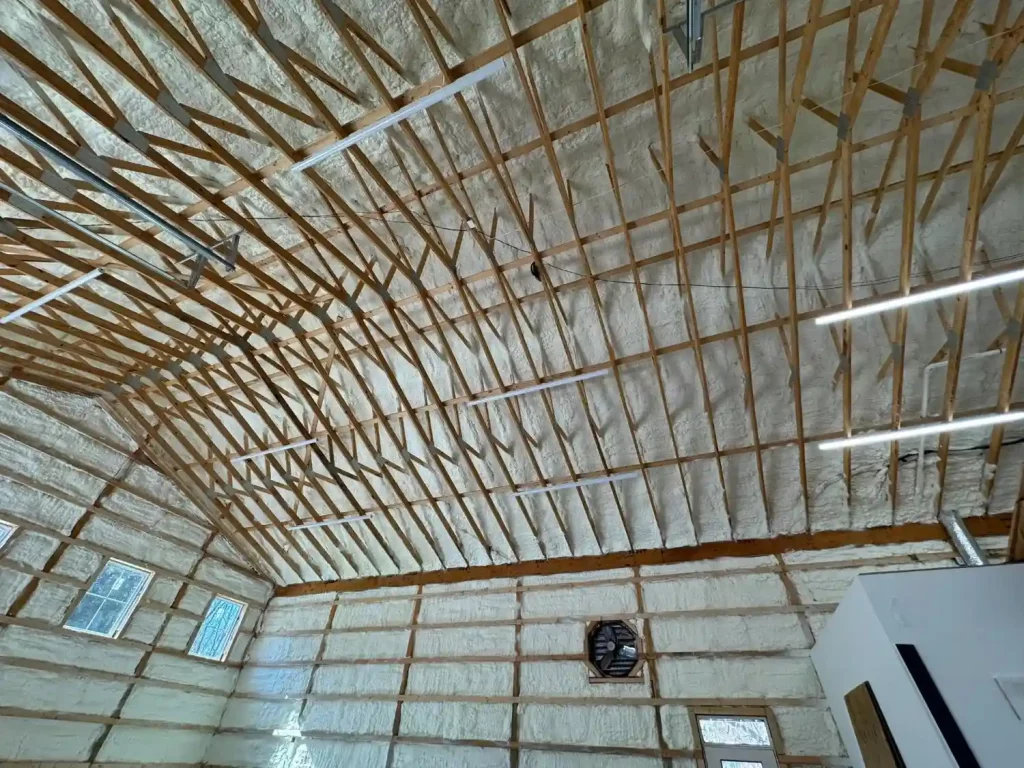
Several variables determine how well insulation controls condensation and energy loss in a specific building. Understanding these factors helps in planning an effective insulation strategy.
Edgewater falls in Climate Zone 4, which means winter temperatures regularly drop below freezing while summers bring sustained heat and humidity. The EPA’s climate zone map, developed by the U.S. Department of Energy, places most of Maryland in this zone. Buildings here must manage both heating-season condensation and cooling-season moisture loads. The insulation system must perform in both directions, keeping warm air inside during winter and preventing humid outdoor air from condensing on cooled interior surfaces during summer.
Building Science Corporation’s condensation control research demonstrates that the ratio of exterior insulation to interior insulation determines condensation risk. Adding more air-permeable insulation inside the cavity without adding exterior insulation can actually increase condensation risk by making the sheathing colder. In a pole barn where spray foam is applied directly to the interior metal surface, the foam itself becomes both the thermal barrier and the air/vapor control layer, keeping the metal surface temperature above the dew point.
The EPA identifies vapor diffusion as one of the transport mechanisms that move moisture through building assemblies. Closed-cell spray foam has a permeability rating below 1 perm, qualifying as a Class II vapor retarder. This blocks moisture from migrating through the insulation layer while still allowing the assembly to dry slowly if any moisture does penetrate from other sources.
A pole barn used for livestock generates far more interior moisture than one used for equipment storage. The EPA’s guidance on HVAC system design notes that high-humidity spaces like indoor pools and agricultural buildings demand careful attention to vapor control. Our technicians assess the intended use of the building to specify the appropriate foam thickness and vapor control strategy.
Even the best insulation material fails if it is poorly installed. Gaps, voids, and incomplete coverage create paths for air leakage and condensation. Spray foam application requires trained technicians who understand proper substrate preparation, spray patterns, and thickness targets to deliver a continuous, effective insulation layer.
For homeowners and building owners in Edgewater considering pole barn insulation, these steps provide a clear path to controlling condensation, moisture, and energy loss.
Peninsula Insulation, LLC specializes in spray foam insulation for pole barns and metal buildings throughout the Edgewater area. Our experienced team evaluates each building’s specific conditions, including usage, moisture loads, and existing construction, then recommends and installs the right insulation solution to prevent condensation, stop moisture damage, and reduce energy waste. Whether your pole barn serves as a workshop, agricultural building, equipment storage, or converted living space, we have the expertise to protect your investment.
Request a Quote | Schedule a Moisture Assessment
Contact Peninsula Insulation, LLC at (410) 770-2624 or email wil@mdsprayfoam.net to discuss your pole barn insulation needs. Our professionals are ready to help you eliminate condensation problems and make your building comfortable and efficient year-round.
Fiberglass batts can provide R-value, but they do not create an air barrier or a vapor barrier on their own. In a pole barn with exposed metal framing, this means air and moisture can still reach cold metal surfaces and condense, regardless of the batt insulation thickness.
For Climate Zone 4 pole barns, 2 inches of closed-cell spray foam on the roof deck typically provides sufficient R-value and condensation control. Thicker applications may be warranted for heated buildings or those with high interior moisture loads.
Yes. Closed-cell spray foam applied directly to the underside of the metal roof deck raises the metal surface temperature above the dew point of the interior air, which prevents condensation from forming on the panels.
No. Closed-cell spray foam with a permeability below 1 perm functions as a Class II vapor retarder without requiring an additional plastic sheet or vapor barrier material.
Yes. Spray foam insulation is an effective retrofit solution for existing pole barns. Our team can assess the current conditions, address any existing moisture damage, and apply spray foam to the interior surfaces to create a continuous insulated envelope.