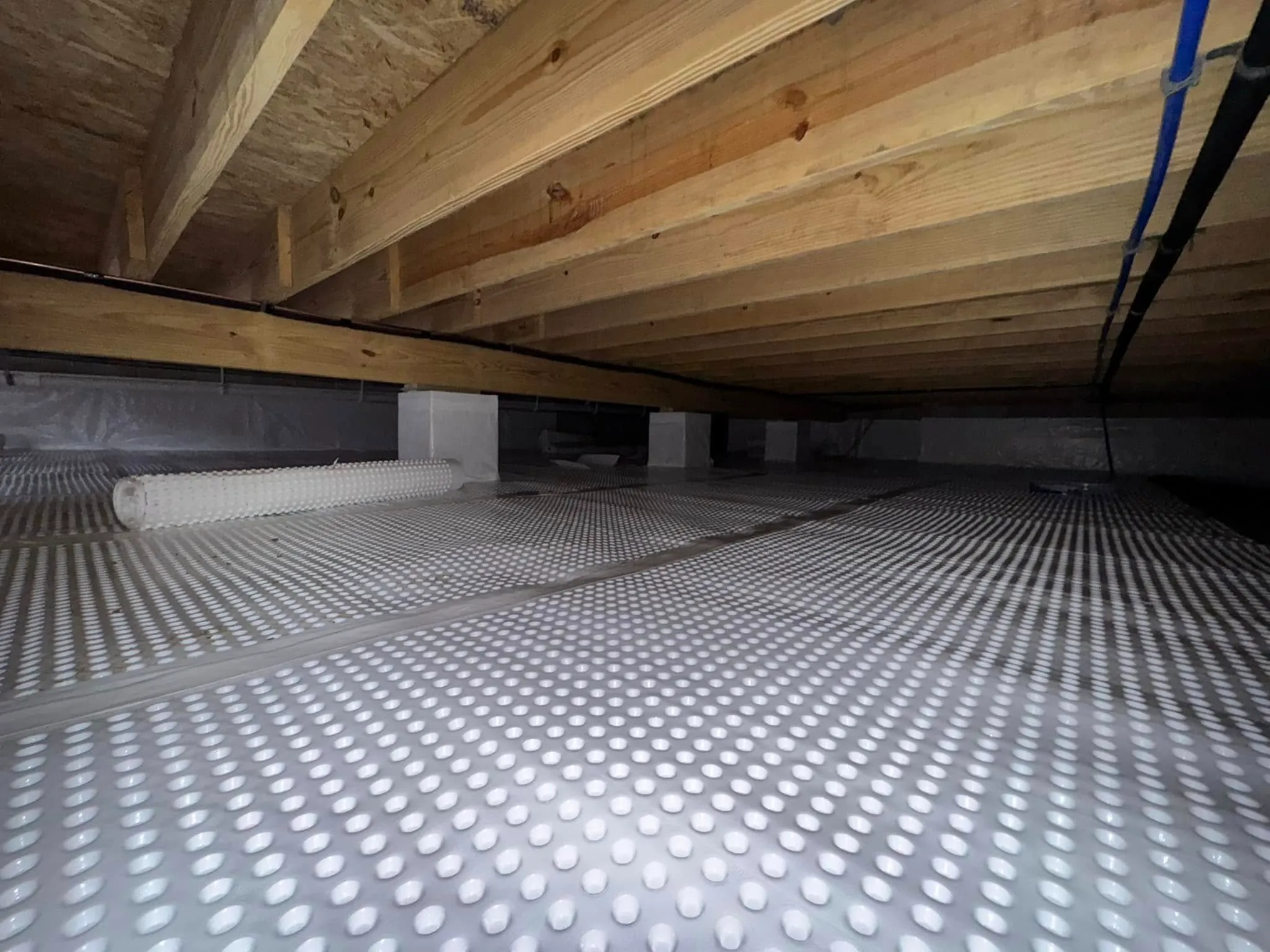
What Materials Are Commonly Used for Crawl Space Encapsulation in 2026, and Why Do They Matter?
Most crawl space encapsulation material choices in 2026 fall into five groups: a polyethylene vapor barrier over the soil and…


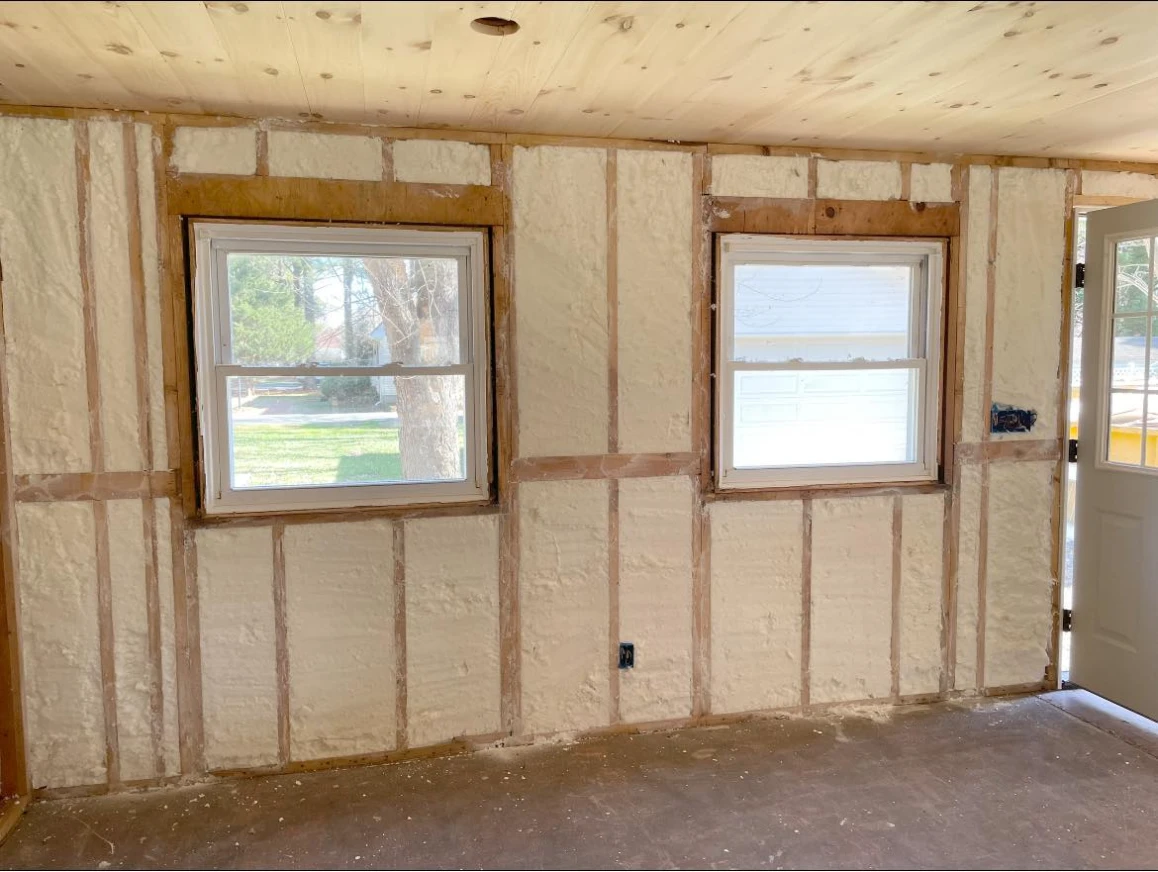
Choosing spray foam insulation for interior walls comes down to one question: does it actually outperform batts and blown-in material enough to justify the switch? For most homes, yes. Spray foam expands to fill the full wall cavity, seals air leaks as it cures, and holds its R-value for decades instead of settling or compressing over time. As part of a broader residential insulation plan, it addresses two problems that traditional insulation handles separately: thermal resistance and air sealing.
This guide breaks down the real R-value numbers, how open-cell and closed-cell foam differ for interior applications, whether it works in existing finished walls, and what to expect before a crew shows up.
TL;DR: Closed-cell spray foam delivers R-6 to R-7 per inch, and open-cell delivers R-3.5 to R-4 per inch, both ahead of fiberglass batts at R-3.2 to R-3.8. The real advantage is air sealing, since spray foam expands into gaps around wiring and framing that other materials leave open. It works in new construction and, with more labor, in existing interior walls too.
Spray foam insulation R-value per inch depends entirely on which type is used. Closed-cell foam is denser and achieves R-6 to R-7 per inch, while open-cell foam expands more and settles around R-3.5 to R-4 per inch. Fiberglass batts, by comparison, deliver only R-3.2 to R-3.8 per inch, and that number drops further if the batt gets compressed during installation.
| Material | R-Value per Inch | Air Sealing | Moisture Resistance |
| Closed-Cell Spray Foam | R-6 to R-7 | Excellent | Superior |
| Open-Cell Spray Foam | R-3.5 to R-4 | Excellent | Good |
| Fiberglass Batts | R-3.2 to R-3.8 | Poor | Poor |
| Cellulose Blown-In | R-3.6 to R-3.8 | Fair | Fair |
R-value alone doesn’t tell the full story, though. Spray foam’s expansion fills gaps around electrical boxes and irregular framing that batts simply can’t reach, which is where most of the real-world performance difference comes from.
The choice between spray foam interior wall applications usually comes down to climate and budget. Open-cell foam is lighter, less expensive per square foot, and provides strong soundproofing, which makes it a common choice for standard residential interior walls. It’s also vapor permeable, so it allows some drying to the interior.
Closed-cell foam costs more but adds structural rigidity and functions as a near-complete vapor barrier, which matters in humid climates or basement-adjacent walls where moisture control is a priority. If you’re weighing the two for a specific project, our breakdown on open-cell spray foam for homeowners covers what to expect from density, cure time, and coverage.
For walls where moisture is a bigger concern than budget, closed-cell spray foam insulation is generally the better call.
Spray foam insulation for existing interior walls is possible, but it’s a different job than new construction. Since the cavity is already closed in, installers need to drill access holes or remove sections of drywall to inject foam, then patch and finish afterward. It’s more labor intensive than a batt retrofit, but it delivers a meaningfully better air seal in older homes where wall cavities were never insulated to begin with.
Homes built before modern energy codes often have wall cavities that are empty or filled with settled, ineffective material. Spray foam insulation inside walls in these cases can noticeably reduce drafts and temperature swings between rooms, especially in homes with older single-pane windows or minimal attic insulation.
A spray foam wall cavity behaves differently than one filled with fibrous insulation. Closed-cell foam is dense enough to act as its own vapor control layer, which reduces the risk of condensation forming inside the wall. According to the Building Science Corporation’s residential spray foam guide, spray foam applications significantly reduce exterior air leakage, which directly cuts down on the moisture that would otherwise migrate into wall cavities and condense.
That matters beyond comfort. Damp, poorly sealed wall cavities create the conditions mold needs to grow, and the CDC notes that dampness and mold exposure are linked to a range of respiratory symptoms. A properly sealed spray foam moisture barrier helps keep wall cavities dry in the first place, rather than dealing with the problem after it starts.
Quick Tip: In humid climates, closed-cell foam’s low vapor permeance is usually the safer choice for walls near bathrooms, kitchens, or below-grade spaces.
The advantages of spray foam insulation go beyond thermal performance. Its adhesive properties add rigidity to the wall assembly itself, and its density (particularly with open-cell foam) provides noticeably better sound dampening between rooms than fiberglass. Unlike batts, it doesn’t sag, settle, or lose R-value over time, which means the performance you get at installation is close to what you’ll still have decades later.
For residential wall insulation projects specifically, the combination of air sealing and thermal resistance in one material also simplifies the installation process, since there’s no separate air-sealing step required before the insulation goes in. The EPA’s guidance on indoor air quality points to sealing and moisture control as two of the most effective long-term strategies for healthier indoor environments, and spray foam addresses both at once.
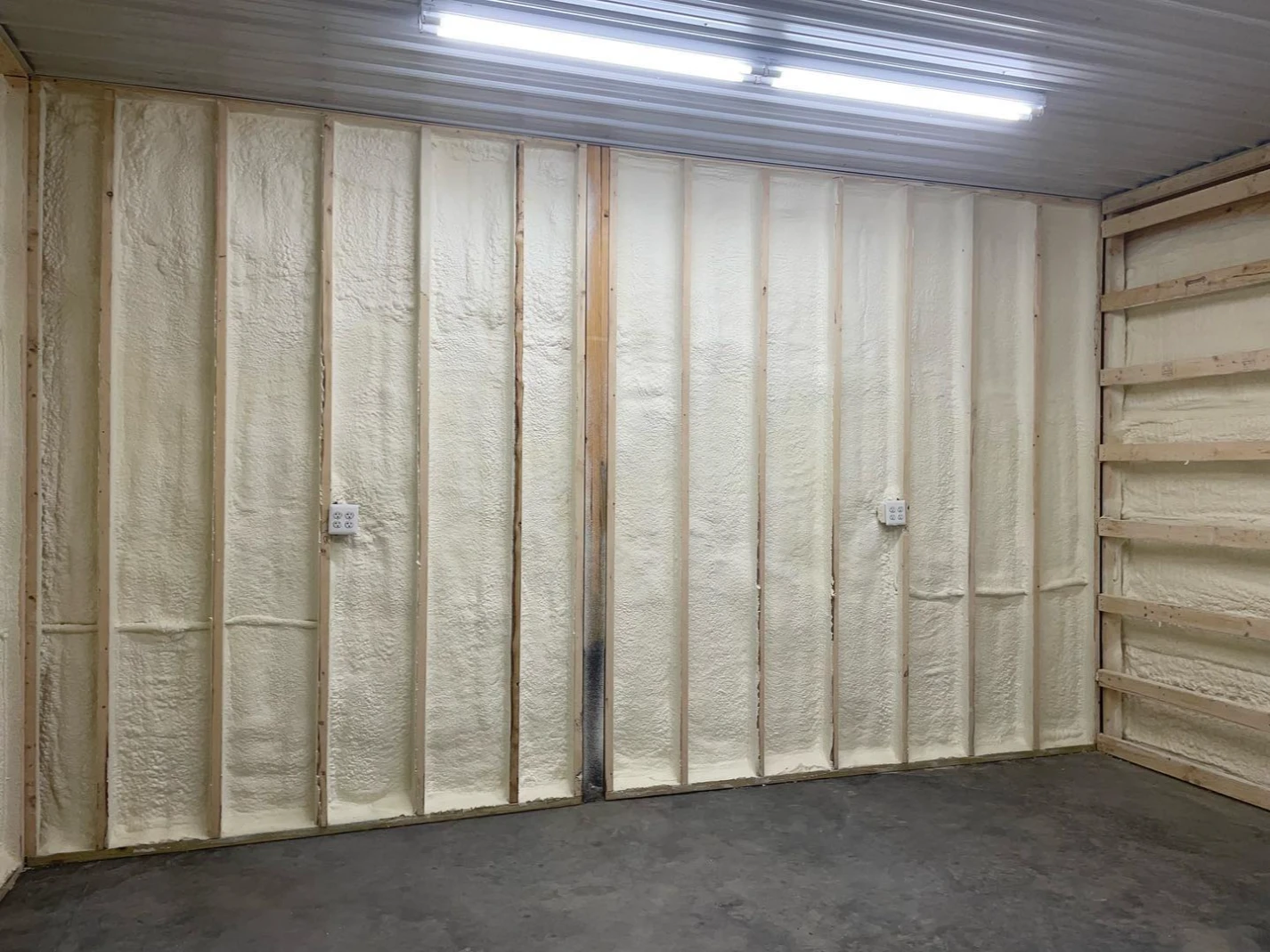
Open-cell foam typically cures within 4 to 8 hours, while closed-cell foam needs 8 to 24 hours depending on thickness and conditions. Full curing is what delivers the final thermal and structural performance.
Yes. Retrofit installation requires access through the wall cavity, usually by removing sections of interior or exterior covering. It’s more involved than new construction work, but it still delivers a real improvement in older homes with empty or degraded wall cavities.
Spray foam generally provides stronger air sealing and moisture control than blown-in cellulose or fiberglass. Blown-in material costs less upfront, but spray foam tends to deliver better long-term energy performance since it doesn’t settle.
Closed-cell foam delivers roughly R-6 to R-7 per inch. Open-cell foam delivers roughly R-3.5 to R-4 per inch. Closed-cell is denser and also adds more structural rigidity and moisture resistance.
No ongoing maintenance is required. Periodic inspection is still a good idea to confirm the thermal barrier is intact and hasn’t been mechanically damaged during other work in the home.
Thinking about upgrading your walls? Get a free quote and have a professional walk you through which foam type fits your home.
Related reading: The Complete Guide to Mineral Wool Insulation for Homeowners and Business Owners
U.S. EPA: Molds and Health for Public Health Professionals
Building Science Corporation: Residential Spray Foam Guide (GM-2102)
CDC: Mold and Dampness, Health Effects